Public Health (MPH)
- Duration: 2 years
- Mode: Part time
Open day
Find out more about studying here as a postgraduate at our next Open Day.
Why study this course
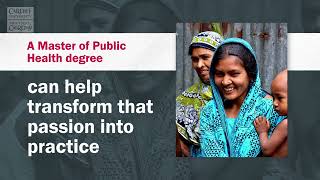
The Master’s in Public Health programme is multi-disciplinary and trans-professional in both its content and the students it generally attracts. The MPH has been run successfully in Cardiff since 1989 and has a national and international reputation.
International reputation
Delivered successfully in Cardiff since 1989, our MPH equips students with the knowledge, skills and critical perspectives needed to address contemporary public health challenges and improve population health.
Relevant to Public Health practice
Study a curriculum based on the UK Faculty of Public Health Membership syllabus which reflects evolving nature of public health practice globally. The Cardiff MPH is a required course for public health registrars training in Wales.
Practice and research-informed learning
Benefit from teaching delivered by researchers and public health professionals from Cardiff University and partner organisations, including Public Health Wales, local health boards and the WHO Collaborating Centre.
Varied dissertation opportunities
Tailor your dissertation to your interests, with opportunities for supervision from leading researchers and public health professionals within Cardiff University and partner organisations, including projects based in practice settings.
A world-leading policy environment
Study in the Welsh capital, home to the Senedd and Welsh Government, and explore public health in a policy environment shaped by a commitment to improving wellbeing for current and future generations.
The programme aims to provide you with the knowledge and understanding required to protect and improve population health and reduce inequalities. In your core modules you’ll explore the basic epidemiological principles that underpin the practice of public health, before going on to apply those principles to practical methods such as assessing population health needs and selecting measures to control disease and promote wellbeing.
You’ll develop skills in data analysis through use of statistical software packages and apply these to interpreting public health information and evidence. You’ll also study the principles of health economics and health policy theory, providing the tools to contribute to addressing major contemporary public health challenges, such as climate change, antimicrobial resistance, obesity and non-communicable diseases.
In addition, option modules will allow you to explore specialist areas of public health and tailor the programme to your interests and career aspirations. The knowledge and skills developed throughout the programme are highly transferrable and relevant to a range of careers across the wider public health workforce.
To gain the Master’s qualification, you will be required to undertake a final dissertation project on a suitable public health topic.
Where you'll study
School of Medicine
We are one of the largest medical schools in the UK, committed to the pursuit of improved human health through education and research.
Admissions criteria
In order to be considered for an offer for this programme you will need to meet all of the entry requirements. Your application will not be progressed if the information and evidence listed is not provided.
With your online application you will need to provide:
- A copy of your degree certificate and transcripts which show you have achieved a 2:2 honours degree in a relevant subject, or an equivalent international degree. If your degree certificate or result is pending, please upload any interim transcripts or provisional certificates.
- A copy of your IELTS certificate with an overall score of 6.5 with 5.5 in all subskills, or evidence of an accepted equivalent. Please include the date of your expected test if this qualification is pending. If you have alternative acceptable evidence, such as an undergraduate degree studied in the UK, please supply this in place of an IELTS.
- A reference (academic or professional) which demonstrates your suitability for the programme. Your referee should comment on your academic ability, motivation for public health, work ethic, and general character. References should be signed, dated and less than six months old at the time you submit your application.
If you do not have a degree in a relevant area, your application may be considered on the basis of at least two years relevant professional experience. Please provide additional evidence to support your application such as signed and dated employer references.
Application Deadline
We allocate places on a first-come, first-served basis, so we recommend you apply as early as possible. Applications normally close at the end of August but may close sooner if all places are filled.
Selection process
We will review your application and if you meet all of the entry requirements, we will make you an offer.
Find out more about English language requirements.
Applicants who require a Student visa to study in the UK must present an acceptable English language qualification in order to meet UKVI (UK Visas and Immigration) requirements.
Criminal convictions
You are not required to complete a DBS (Disclosure Barring Service) check or provide a Certificate of Good Conduct to study this course.
If you are currently subject to any licence condition or monitoring restriction that could affect your ability to successfully complete your studies, you will be required to disclose your criminal record. Conditions include, but are not limited to:
- access to computers or devices that can store images
- use of internet and communication tools/devices
- curfews
- freedom of movement
- contact with people related to Cardiff University.
Course structure
The part-time MPH is delivered in-person across over two academic years, commencing in late September/ early October in the first academic year, with the dissertation submitted in the December after the end of the second academic year. The course consists of two stages – “stage T” (taught stage) and “stage R” (research dissertation stage).
Taught stage
Overall the taught stage consists of six 20-credit modules, totalling 120 credits, at Level 7. You will study four core modules in year one, plus choose two option modules in year two.
You may exit after this stage with a Postgraduate Certificate if you have gained at least 60 credits, only where this includes the award of credit for three out of four of the required modules.
You may exit after this stage with a Postgraduate Diploma if you have gained at least 120 credits, only where this includes the award of credit for all required modules.
Research Dissertation stage
This stage lasts for around six months after the end of the taught stage, and includes a dissertation of 60 credits at Level 7, to achieve a combined total of 180 credits at Level 7 to complete the MPH programme.
The modules shown are an example of the typical curriculum. Final modules will be published one month ahead of your programme starting.
The modules shown are an example of the typical curriculum. Final modules will be published one month ahead of your programme starting.
Year one
Part-time students need to attend 1 day of core module teaching per week. These are scheduled for Wednesdays. In addition to timetabled sessions, you should expect to spend time reading, completing structured learning activities in preparation for classes, and working on assessments throughout the programme. These activities are an integral part of your learning and will help you get the most from your studies. We particularly encourage part-time students to discuss their study commitments with their line manager before the programme begins and, where possible, agree protected time for study. This can help you balance work responsibilities with the demands of postgraduate study and ensure you have sufficient time to engage fully with the programme.
Information about the course will be provided in a course handbook.
| Module title | Module code | Credits |
|---|---|---|
| Statistical Methodology | MET212 | 20 credits |
| Basic Epidemiology | MET413 | 20 credits |
| Applied Epidemiology | MET414 | 20 credits |
| Health Economics, Policy and Planning | MET415 | 20 credits |
Year two
Part-time students need to attend 1 day equivalent of teaching per week, days dependent upon module choices. The need to protect time for independent study continues in the second year of the course.
| Module title | Module code | Credits |
|---|---|---|
| Dissertation: Public Health | MET058 | 60 credits |
| Module title | Module code | Credits |
|---|---|---|
| Health Improvement | MET213 | 20 credits |
| Health Protection | MET214 | 20 credits |
| Global Health | MET410 | 20 credits |
The University is committed to providing a wide range of module options where possible, but please be aware that whilst every effort is made to offer choice this may be limited in certain circumstances. This is due to the fact that some modules have limited numbers of places available, which are allocated on a first-come, first-served basis, while others have minimum student numbers required before they will run, to ensure that an appropriate quality of education can be delivered; some modules require students to have already taken particular subjects, and others are core or required on the programme you are taking. Modules may also be limited due to timetable clashes, and although the University works to minimise disruption to choice, we advise you to seek advice from the relevant School on the module choices available.
Learning and assessment
How will I be taught?
Recognising that students come from diverse backgrounds and have different learning needs, teaching draws on a range of approaches designed to encourage curiosity, critical thinking and independent learning. Each module combines preparatory reading and online learning activities with in-person teaching sessions. This blended approach enables you to explore key concepts and theories in advance, allowing in-person sessions to consolidate and apply learning to public health practice. In-person teaching includes interactive lectures, small-group exercises, case study discussions and practical sessions.
The statistical methodology module utilises statistical software for practical sessions, developing your skills in applying theoretical concepts to support answering public health questions.
All modules within the programme use our virtual learning environment, Learning Central, where you can access structured course materials, including assessment guidance, and which is accessible through laptops, tablets and smartphones. All modules use online discussion forums, which allow you to seek clarification and engage in debate and discussion with lecturers and peers.
During dissertation stage you will be undertaking guided independent study and research. A project supervisor will be allocated to support and advise you on researching and writing up your specific dissertation topic.
How will I be assessed?
You will be assessed through a combination of the following assessment types:
- Unseen exams using short or structured answer questions, or deploying multiple choice questions
- Oral presentations
- Individual written assignments including reports, structured tasks (such as data analysis and critical appraisal), essays and poster presentations
- Group tasks supported by individual reflection
The dissertation stage will be assessed based on a written report of your dissertation project.
How will I be supported?
From the beginning of the course, you will be part of a supportive learning community where students and faculty share knowledge, experiences and ideas. You will be studying with students from a wide range of backgrounds, providing opportunities to learn from each other's expertise, challenge assumptions and develop new perspectives.
You will be allocated a personal tutor who can provide both academic and pastoral support throughout your studies. Your personal tutor will be available to discuss your progress, offer advice and guidance when needed, and meet with you through regular check-ins during the academic year. They can also help you access the wide range of support services available across the University.
The module lead for each module will provide support relating to module content and assessments. This is through both information shared in person, and guidance available via Learning Central. Discussion boards provide a shared space where you can ask questions, seek clarification and share ideas. Responses are visible to the whole cohort, enabling everyone to benefit from the discussion and develop their understanding.
Study skills sessions are built into the first semester modules, including critical writing and literature searching skills. A range of staff are available to provide further support, including a specialist librarian.
Formative assessment is incorporated into all modules, providing an opportunity to receive feedback that does not contribute to your progression or degree classification decisions. This can include specific tasks, presentations, practice questions and essay plans. Feedback is also provided on summative assessments, indicating how well you have succeeded in meeting the intended learning outcomes, enabling you to identify any actions required in order to continuously improve.
What skills will I practise and develop?
The Learning Outcomes for this Programme describe what you will be able to do as a result of your study at Cardiff University. They will help you to understand what is expected of you.
The Learning Outcomes for this Programme can be found below.
On successful completion of the Programme you will be able to demonstrate the ability to:
Knowledge & Understanding
- Critically evaluate routine epidemiological measures of health and disease, including public health and epidemiological research methods and methodologies, critically appraising the rigour and validity of such to address population health questions and inform decision making.
- Reflect on the role of epidemiology and its’ contribution to public health, including health surveillance, health protection and health promotion using contemporaneous evidence to support discussions and implementation, appreciating the different political and economic contexts and how and why interventions must be tailored to different situations.
- Critically analyse and interpret the distributions and determinants of health and disease grounding these in theoretical perspectives that help understand the impact of behaviour and social determinants of health and well-being.
- Strategically plan the investigation of public health problems, integrating the ability to develop a robust health needs assessment with valid measures to control disease and promote well-being through critical evaluation using high -quality evidence and clinical judgement and addressing issues of equality, efficiency and healthcare planning.
- Synthesise management and leadership theory to explore their impact on change on management, teamworking, policy, strategy and organisational function, including health service financing.
- Critically debate the concepts that underpin heath economics and synthesise to practice, the most appropriate health economic models to use in the healthcare context justifying models to practical scenario.
- Critically analyse the management of outbreaks of communicable diseases and evaluate public health surveillance systems.
- Synthesise quality improvement theory and research to facilitate critical review of clinical practice, including the critique of different theoretical approaches to designing and evaluating public health improvement interventions
- Debate concepts of health education, health literacy, and health consciousness and the processes by which they determine health-related lifestyle behaviours and choices synthesising models around the social determinants of health and wellbeing.
Intellectual Skills
- Critically debate with informed colleagues on key public health matters
- Evaluate the effectiveness of interventions through audit, service evaluation and research
- Assess the appropriateness of various statistical techniques for inferential analysis of data, apply appropriately, using the logical progression of data analysis effectively and interpret results in a statistical context, appreciating the results from a public health perspective
- Use epidemiological data to analyse a problem and formulate an appropriate response, providing a rationale for the actions proposed
Professional Practical Skills
- Assess practical approaches to contemporaneous and specific health challenges
- Use statistical software to produce appropriate tables, diagrams and summary statistics for presentation of data
- Perform appropriate statistical analyses to interrogate public health data and data collected in research studies using statistical software
- Appreciate a stakeholder perspective on defining and addressing public health issues, and understand the roles and responsibilities of different domestic and international agencies
- Demonstrate fluency in health economic terminology
- Use epidemiological techniques to evaluate surveillance systems and to undertake field investigation
- Develop, deliver and evaluate health promotion activities being cognisant of the ideological dilemmas, behaviour, social factors and policy assumptions underlying different approaches
- Synthesise and judge the appropriate level of information to communicate to a range of public health audiences including senior managers, groups or individuals representing the public, politicians and the media understanding their roles and responding appropriately to request for information.
Transferable/Key Skills
- Communicate information clearly both orally and in writing, especially in relation to media responses
- Search for and critically evaluate evidence and synthesise to practice
- Problem solve and plan logically, solving problems independently and in small working groups
- Demonstrate negotiation skills and work well within a team setting, consulting with colleagues and acting professionally at all times
- Recognise and work within the limits of professional competence
- Use the internet to source current information about local, national and global health issues
- Reference correctly using Harvard convention
- Debate effectively in a multi-stakeholder environment in order to promote public health concerns
Tuition fees for 2027 entry
Your tuition fees and how you pay them will depend on your fee status. Your fee status could be home, island or overseas.
Learn how we decide your fee status
Fees for home status
| Year | Tuition fee | Deposit |
|---|---|---|
| Year one | £5,725 | None |
| Year two | £5,725 | None |
Fees for overseas status
| Year | Tuition fee | Deposit |
|---|---|---|
| Year one | £14,100 | £3,000 |
| Year two | £14,100 | None |
More information about tuition fees and deposits, including for part-time and continuing students.
Financial support
Financial support may be available to individuals who meet certain criteria. For more information visit our funding section. Please note that these sources of financial support are limited and therefore not everyone who meets the criteria are guaranteed to receive the support.
Additional costs
Will I need any specific equipment to study this course/programme?
You will need a reliable computer with high speed internet access (and up-to-date virus and malware protection) and appropriate software.
Living costs
We’re based in one of the UK’s most affordable cities. Find out more about living costs in Cardiff.
Funding
Career prospects
MPH graduates can choose to enter the workforce, either in the public health or healthcare sector, or indeed apply public health principles in any other sector (e.g., housing, engineering, urban design, architecture, computer science, business, entrepreneurship, law, or journalism). Graduates may also apply for further training in research (e.g., PhD) or practice (e.g., fellowships, specialist training, etc).
The course helps students in their preparation for the UK Faculty of Public Health Part A examinations, enabling graduates to pursue professional careers in public health as well as a wide range of other careers, including postgraduate research.
This Masters programme enables you to demonstrate you are taking the opportunity to develop your abilities in critical analysis, problem-solving, decision-making, finding and using evidence and in dealing with complex issues. The programme is not a substitute for a formal specialty training programme but studying at this level should help successful students demonstrate numerous academic skills that should be highly regarded in relation to their career development and progression. In particular, the programme offers opportunities to demonstrate the development of knowledge and skills in relation to the application of evidence-based medicine and the potential enhancement of services and governance frameworks. As such, it should provide evidence of commitment and potential that may assist you in relation to taking on greater responsibilities or perhaps seeking management, research, scholarship, or leadership roles.
"Studying the Master of Public Health (MPH) course at Cardiff University provided me with invaluable knowledge and skills when it came to applying for Public Health Specialty Training. I recently secured a place to start the specialty training, and I'm certain that having already commenced study of the MPH made the difference between being successful or not."
Oliver Williams, MPH student (enrolled 2018)
‘With a background in Environmental Geoscience I had a lot to learn about Public Health. However, with the enthusiasm and supportiveness of staff and public health experts, I completed the MPH feeling proud of what I had achieved. The comprehensive nature of the taught modules provided a detailed grounding, enabling me to apply and explore the wider context based on this knowledge. The culmination of my studies was the dissertation, where I had the opportunity to analyse raw data from Médecins Sans Frontières (Doctors Without Borders), to explore risk factors in severity and death from Hepatitis E in refugee camps in South Sudan. Upon completion of my MPH, I was motivated to continue my Public Health research and took up a PhD studentship at the University of Birmingham, with the objective to inform health interventions for indoor air pollution in Urban Rwanda. The skills and knowledge gained from the MPH have been invaluable during my first months of my PhD, enabling me write a paper for publication using pilot data.’
Katherine Woolley, MPH 2017-18
'I have learned so much about the different areas of public health from the team associated with this programme. The Team’s tireless pursuit of academic excellence and professional insight were a source of constant encouragement and strong motivation for me to achieve this Masters. I’ve returned to India with increased knowledge and priceless suggestions. I am extremely grateful for their unrelenting support and guidance throughout'
Next steps
Open Day visits
Register for information about our upcoming dates.Make an enquiry
Contact us for more information about this course.International
Learn more about our truly global university.Discover more
Related searches: Healthcare, Medicine, Social sciences
HESA Data: Copyright Higher Education Statistics Agency Limited 2021. The Higher Education Statistics Agency Limited cannot accept responsibility for any inferences or conclusions derived by third parties from its data. Data is from the latest Graduate Outcomes Survey 2019/20, published by HESA in June 2022.
