Global Ecology and Conservation (MSc)
- Duration: 1 year
- Mode: Full time
Open day
Find out more about studying here as a postgraduate at our next Open Day.
Why study this course
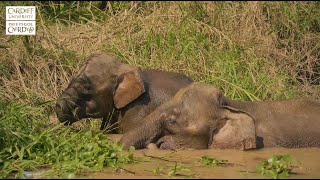
Our MSc in Global Ecology and Conservation trains the ecologists and conservationists of the future.
Latest conservation trends
Learn the concepts and challenges in conservation, including in legislative and NGO contexts, and ‘horizon-scanning’ for future threats.
Practical training
Develop environmental impact assessments and management plans, and survey species and ecosystems using established and new technologies such as eDNA
Field courses in the UK or abroad
You'll undertake a 1-2 week field course with a choice of working in the UK or in international destinations.
Expert contributors
We have regular contributions from leading experts in ecology, conservation, and environmental management.
Placement opportunities
You'll undertake a 10-day professional work placement tailored to your interests and career aspirations.
With a changing climate, an increasing human population, and growing rates of extinction and habitat loss, the world is facing unprecedented challenges. Covering the complete span from ecological theory and pioneering research, through to practical site assessments and conservation interventions, we equip you with the skills and knowledge required to tackle major global challenges and make a ‘real world’ difference.
From the rivers of South Wales to the Bornean rainforest, our MSc covers the major conservation issues affecting habitats across the globe. With training in core areas, such as wildlife surveys, biodiversity assessments and species management, you learn how to identify current and emerging threats to species and ecosystems and develop the necessary skills to tackle these threats with effective and scalable solutions. These are bolstered by training in complementary topics including data handling and geographical information systems (GIS), which are essential employability skills in ecology and conservation.
There is scope to tailor the course to your interests and career aspirations, with a range of options for your professional work placement, field course, and final research project (dissertation). Depending on your choices, you could potentially spend several months working in the field during your MSc.
The course is delivered by leading academics who work across the world conducting cutting-edge research and addressing key global challenges – from pioneering climate change research, to developing action plans to preserve native species. As well as offering you the excitement of learning in an active research environment, this approach will also demonstrate how your work can be translated into practical conservation measures.
You’ll receive training in data handling, analysis, and visualisation, using publicly available biodiversity data and learn how to archive your own data for others to use. In addition, science communication is embedded across the course, where you’ll learn to interact with different individuals and organisations, and use different formats to target audiences from the general public through to policy makers and funding bodies.
We know that ecology and conservation are constantly evolving, and, in response, we have developed an MSc that is explicitly forward-looking, covering new technology and ‘horizon scanning’ for future conservation issues. With a flexible and interdisciplinary approach, we aim to train postgraduates who can take on roles in research, practice, policy, consultancy and more, and who have the skills, confidence and knowledge base to adapt to a global job market and changing environment.
The course is well-structured, beginning with core theoretical and practical training, followed by hands-on research allowing us to apply our knowledge in a real-world context. One of the most valuable aspects was the freedom to tailor our research project around our own interests, enabling me to explore a direction I was truly passionate about.
We're committed to delivering programmes that are innovative and relevant, providing the best learning outcomes and career prospects for our students. In light of this, we're currently reviewing some elements of this programme. As such, the details shown are subject to change and indicative only. You can still apply now. We'll update this page and contact all offer holders when the review is complete to confirm any changes.
Where you'll study
School of Biosciences
We provide a dynamic and stimulating teaching environment with impressive modern facilities, up-to-date equipment and high-calibre staff.
Admissions criteria
To be considered for an offer for this course, you will need to meet all the entry requirements. Your application will not be progressed if the information and evidence listed is not provided.
With your online application you will need to provide:
- A copy of your degree certificate and transcripts which show you have achieved a 2:1 honours degree in a relevant science subject such as biology, ecology, zoology, physical geography or environmental science, or an equivalent international degree. If your degree certificate or result is pending, please upload any interim transcripts or provisional certificates.
- A copy of your IELTS certificate with an overall score of 6.5 with 5.5 in all subskills, or evidence of an accepted equivalent. Please include the date of your expected test if this qualification is pending. If you have alternative acceptable evidence, such as an undergraduate degree studied in the UK, please supply this in place of an IELTS.
If you do not have a degree in a relevant area, your application may be considered based on professional or other extensive experience in conservation or environmental management. Please provide additional evidence to support your application such as signed and dated employer references.
Application Deadline
We allocate places on a first-come, first-served basis, so we recommend you apply as early as possible. Applications normally close at the end of August but may close sooner if all places are filled.
Selection process
We will review your application and if you meet all of the entry requirements, we will make you an offer.
Find out more about English language requirements.
Applicants who require a Student visa to study in the UK must present an acceptable English language qualification in order to meet UKVI (UK Visas and Immigration) requirements.
Criminal convictions
You are not required to complete a DBS (Disclosure Barring Service) check or provide a Certificate of Good Conduct to study this course.
If you are currently subject to any licence condition or monitoring restriction that could affect your ability to successfully complete your studies, you will be required to disclose your criminal record. Conditions include, but are not limited to:
- access to computers or devices that can store images
- use of internet and communication tools/devices
- curfews
- freedom of movement
- contact with people related to Cardiff University.
Course structure
MSc Global Ecology and Conservation is a one-year, full-time programme. You undertake modules to the value of 180 credits.
Stage 1, the taught component of the course, runs from September up until spring (around Easter), with reading weeks in both autumn and spring semesters. You will study six 20 credit modules.
Stage 2 comprises your research project (dissertation; 60 credits in total) and runs from May to September.
The modules shown are an example of the typical curriculum. Final modules will be published one month ahead of your programme starting.
Taught Stage
The taught stage (Stage 1) runs from September to shortly after Easter and comprises the six core modules (all 20 credits). These are designed to build your background knowledge, understanding and skills in key areas of ecology and conservation, including field skills, biodiversity assessment, conservation biology and data handling. There is plenty of choice within these modules, such as different scenarios or species to address in coursework assignments, the location of your professional work placement, and choice of field course destination and research project during the field course. With a few exceptions (e.g. field courses), the in-person teaching is timetabled for three days per week, giving you plenty of flexibility within the week to organise your time (e.g. for self-directed learning and coursework, carrying out your work placement or for part-time employment).
Dissertation Stage
On successfully completing the taught stage (Stage 1), you will undertake a full-time research project of your choice between May and September (Stage 2). The project can be field- or lab-based, or involve analysing an existing data set, and will be supervised by at least one member of academic staff from the School of Biosciences. A wide range of topics are possible: a list of potential topics is provided, but you are also encouraged to develop your own ideas in collaboration with a member of staff. The final assessment from this stage includes a written report and accompanying presentation of your findings. Stage 2 culminates in the submission of an MSc Dissertation, based on your MSc project findings. During this period, you will be embedded in an active research group, gaining an authentic research experience alongside leading academics, post-doctoral researchers and PhD students.
| Module title | Module code | Credits |
|---|---|---|
| Field Skills for Ecology and Conservation | BIT050 | 20 credits |
| Assessing Biodiversity and Ecosystems | BIT051 | 20 credits |
| Principles and Practice of Conservation Biology | BIT052 | 20 credits |
| Data Science | BIT053 | 20 credits |
| Field Research and Placement | BIT055 | 20 credits |
| Integrated Water Sciences for the real world | BIT060 | 20 credits |
| Research Project | BIT054 | 60 credits |
The University is committed to providing a wide range of module options where possible, but please be aware that whilst every effort is made to offer choice this may be limited in certain circumstances. This is due to the fact that some modules have limited numbers of places available, which are allocated on a first-come, first-served basis, while others have minimum student numbers required before they will run, to ensure that an appropriate quality of education can be delivered; some modules require students to have already taken particular subjects, and others are core or required on the programme you are taking. Modules may also be limited due to timetable clashes, and although the University works to minimise disruption to choice, we advise you to seek advice from the relevant School on the module choices available.
Learning and assessment
How will I be taught?
The taught component of the programme is delivered through a mix of lectures, seminars, tutorials, computer practicals and field-based teaching, including a c. 10–15-day field course in a choice of UK and international destinations.
How will I be assessed?
You will be assessed through a combination of coursework, essays, presentations and a research project (dissertation).
How will I be supported?
You will receive supervision during your dissertation period and be allocated a personal tutor who will support you throughout your studies. There are lots of useful course materials on provided on our virtual learning platform to complement your independent study.
Our dedicated Student Support Team will also be on hand to support you with all aspects of your student life, from health, wellbeing and study skills, to career planning, finances and accommodation.
What skills will I practise and develop?
On successful completion of the Programme you will be able to:
Knowledge & Understanding:
- Discuss key principles underlying ecology and conservation, especially as they relate to environmental and global change.
- Distinguish different facets of biodiversity (e.g. functional, taxonomic) at scales ranging from genes to ecosystems, and explain how to quantify them and their changes through space and/or time
- Describe different field survey techniques, with accompanying safe working practices and relevant legislation
- Assess current and emerging threats to biodiversity, alongside relevant policy/legislation and conservation interventions (e.g. re-introduction, re-wilding or creating conservation corridors)
- Understand the complex challenges and potential conflicts involved in managing the natural environment and resources (e.g. freshwater), and the importance of multi-/inter-disciplinary management strategies.
Intellectual Skills:
- Recommend management strategies, underpinned by ecological principles and evidence, to conserve species and/or manage nature conservation sites
- Formulate research questions and testable hypotheses when presented with general research scenarios.
- Select suitable methods for analysing data and visualising the results
- Diagnose the drivers of biodiversity/ecosystem change from data.
- Critically evaluate: i) ecological survey methods and data collected using those methods, ii) environmental impact assessments; iii) the results of data analyses; and iv) published research from the scientific literature
- Organise the components of a research project (background/context of the work; methods; analysis and presentation of the results; critical evaluation of the work; conclusions) into a written report, following the format of a scientific paper
Professional Practical Skills:
- Design field surveys and research projects to address specific aims or hypotheses
- Collect data for different taxa and environments, using established and cutting-edge methods relevant to both research and applied contexts (e.g. ecological consultancy)
- Select, and justify the choice of, suitable approaches for measuring different aspects of biodiversity when presented with ecological and conservation scenarios or research questions
- Critically evaluate different statistical methods and select appropriate ones when presented with scenarios and associated data sets.
- Use industry-standard software (e.g. R and QGIS) to analyse data, and design and construct digital maps.
- Synthesise, critique and communicate research outputs (e.g. scientific papers, data analyses) to scientific peers in written and oral formats
- Interpret and apply legal guidelines to project proposals or survey designs
Transferable/Key Skills:
- Synthesise complex scientific outputs (e.g. scientific papers, data analyses, environmental impact assessments) into written and oral formats tailored to a non-specialist audience (e.g. policy makers, general public)
- Prepare written reports, with clear structures and organising information in a logical manner, using correct grammar/spelling
- Select and apply appropriate tools (e.g. scientific databases, AI tools, systematic search strategies) to identify pertinent and authoritative scientific literature about a topic
- Develop a convincing case for support, arguing for the need for investment in a research project, policy or other area.
- Analyse, visualise and interpret complex data, and formatting data sets and analysis code to facilitate collaboration and long-term archiving
- Design and manage short (1-2 weeks) and longer-term (3-4 months) research projects, and apply safe working practices when carrying out fieldwork and/or laboratory work
- Reflect on your own performance in professional working environments, identifying strengths, weaknesses and areas for improvement
Tuition fees for 2027 entry
Your tuition fees and how you pay them will depend on your fee status. Your fee status could be home, island or overseas.
Learn how we decide your fee status
Fees for home status
| Year | Tuition fee | Deposit |
|---|---|---|
| Year one | £12,450 | None |
Fees for overseas status
| Year | Tuition fee | Deposit |
|---|---|---|
| Year one | £30,950 | £3,000 |
More information about tuition fees and deposits, including for part-time and continuing students.
Financial support
Financial support may be available to individuals who meet certain criteria. For more information visit our funding section. Please note that these sources of financial support are limited and therefore not everyone who meets the criteria are guaranteed to receive the support.
Additional costs
The programme offers a choice of field courses. At least one is based in or close to Cardiff and will have no additional costs associated with it; you will be guaranteed a place on this course if it is your first choice. If you wish to attend a residential field course (UK or overseas), there will be additional costs associated with travel, accommodation and subsistence. Locations may include Pembrokeshire, Tobago and Borneo, and costs range from approximately £600 (Pembrokeshire) to £1800 (Borneo), excluding travel to and from the field location. Please contact the School of Biosciences for further information on field course costs.
No additional charges are made for other aspects of tuition, although some services (such as student printing on demand) may incur a charge
Will I need any specific equipment to study this course/programme?
No specific equipment is required. The University will provide IT facilities (in a communal space), laboratories equipped with specialist equipment, and all specialist software required for the course.
Students are advised to have a personal laptop computer or equivalent.
Living costs
We’re based in one of the UK’s most affordable cities. Find out more about living costs in Cardiff.
Funding
Careers and placements
Our MSc offers excellent training for future ecologists and conservationists. Its blend of theory and practical research skills, conservation management and legislation, and identifying emerging threats, will furnish you with the scientific knowledge, hands-on experience and adaptability that are highly valued by employers in today’s global job market.
We expect many of our graduates to enjoy successful careers in research, ecological consultancy, and conservation policy and practice. With its focus on practical training in both subject-specific and generic research skills, our MSc provides the ideal platform for further study and a career in academia.
Alongside sound scientific training, this course will enable you to develop transferable skills that are in high demand beyond ecology and conservation. Skills such as data management, analysis and literacy; making complex research accessible to a wide audience; appraising alternative management proposals and policies; and devising evidence-based solutions to problems, are vital in a range of roles across the public, private and third sectors.
Throughout the course, you will have a wide range of opportunities to establish contacts with potential employers, whether that’s through a work experience placement, collaborations developed during the research project, or guest lectures by leading external experts.
Placements
This course offers multiple opportunities to develop your practical research skills via fieldwork modules and a professional placement.
Direct experience of different habitats and fieldwork techniques is an important part of an ecologist’s training, and are at the heart of two core modules. Depending on the topic selected, your research project may also offer the opportunity for extensive fieldwork.
You can choose from a range of field courses (approximately 10-15 days), both here in the UK and in international locations
You will also undertake 10-day placement at a relevant organisation such as a conservation NGO, research laboratory, field centre, museum or zoological institute that you will arrange with support and guidance from University staff. Placements could be in Cardiff, elsewhere in the UK or overseas.
In total, you can choose to spend approximately one month in the field as part of your taught modules (not including the research project, which can also be field-based), enabling you to develop practical ecology and conservation skills that can be taken all over the world.
Next steps
Open Day visits
Register for information about our upcoming dates.Make an enquiry
Contact us for more information about this course.International
Learn more about our truly global university.Discover more
Related searches: Biosciences
HESA Data: Copyright Higher Education Statistics Agency Limited 2021. The Higher Education Statistics Agency Limited cannot accept responsibility for any inferences or conclusions derived by third parties from its data. Data is from the latest Graduate Outcomes Survey 2019/20, published by HESA in June 2022.
