Digital Media and Society (MA)
- Duration: 1 year
- Mode: Full time
Open day
Find out more about studying here as a postgraduate at our next Open Day.
Why study this course
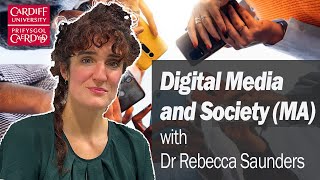
Explore how new, digital media impact societies in crucial ways and learn how digital media and technologies shape industry, culture, politics, human rights and the environment.
Active research
Develop your own research project, with world-leading researchers as your supervisors, specialise with optional modules, and access support from the Academic Skills team.
Cardiff central
You’ll be based in the heart of Cardiff’s vibrant media quarter in a purpose-built facility adjacent to the new BBC Cymru/Wales building.
Understand digital society
Gain an understanding of digital media and technologies’ role and impact on contemporary culture and society and explore digital cultures, internet governance, datafication and digital rights.
Research excellence
Join a global leader in researching media and society – currently 2nd in the UK for the quality of our research.
Real-world skills
Develop your practical skills – like synthesising and integrating qualitative information and data in reports, group work and large research projects - and access our Student Futures employment support.
The emergence of new digital communication platforms has had significant impacts. Audiences are transforming into media producers; new business models are emerging; social media campaigns create new forms of politics; digital culture highlights practices of sharing and participation; and data collection and analytics affect an increasing part of our lives.
This offers new possibilities for digital citizens, but it also raises new questions regarding classic notions of privacy and freedom of expression, and it renders information and digital infrastructure a key resource.
MA Digital Media and Society addresses current challenges of online communication and internet studies. It enables you to develop specialist knowledge in areas such as social media, big data, citizen journalism, digital culture, the creative industries, internet governance, and digital rights. It also provides a theoretical and methodological grounding in media and communication studies.
This course provides you with a thorough understanding of the current transformations and with the analytical skills to investigate digital media in the context of social, political and economic change. We ask how online communication is shaped by users, states and businesses, and how our society is, in turn, affected by digital media.
This course draws on the strength and diversity of Cardiff University’s staff, giving you a unique opportunity to work with academics whose research explores issues such as citizen journalism, online activism, big data, internet surveillance, internet governance and digital rights.
You can get involved in our Research Group Digital Media and Society and thus become part of a dynamic research environment.
Please note this course focuses on academic research and does not provide practical training.
Where you'll study
School of Journalism, Media and Culture
We provide a scholarly environment to help you acquire both the knowledge and skills needed to enter your chosen area of the media.
Admissions criteria
In order to be considered for an offer for this programme you will need to meet all of the entry requirements. Your application will not be progressed if the information and evidence listed is not provided.
With your online application you will need to provide:
- A copy of your degree certificate and transcripts which show you have achieved a 2:2 honours degree in a relevant subject such as arts, humanities or social sciences, or an equivalent international degree. If your degree certificate or result is pending, please upload any interim transcripts or provisional certificates.
- A copy of your IELTS certificate with an overall score of 6.5 with 6.0 in all subskills, or evidence of an accepted equivalent. Please include the date of your expected test if this qualification is pending. If you have alternative acceptable evidence, such as an undergraduate degree studied in the UK, please supply this in place of an IELTS.
If you do not have a degree, your application may be considered on the basis of your professional experience. Please provide additional evidence to support your application such as signed and dated employer references.
Application Deadline
We allocate places on a first-come, first-served basis, so we recommend you apply as early as possible. Applications normally close at the end of August but may close sooner if all places are filled.
Selection process
We will review your application and if you meet all of the entry requirements, and places are still available, we will make you an offer.
Find out more about English language requirements.
Applicants who require a Student visa to study in the UK must present an acceptable English language qualification in order to meet UKVI (UK Visas and Immigration) requirements.
Criminal convictions
You are not required to complete a DBS (Disclosure Barring Service) check or provide a Certificate of Good Conduct to study this course.
If you are currently subject to any licence condition or monitoring restriction that could affect your ability to successfully complete your studies, you will be required to disclose your criminal record. Conditions include, but are not limited to:
- access to computers or devices that can store images
- use of internet and communication tools/devices
- curfews
- freedom of movement
- contact with people related to Cardiff University.
Course structure
This is a one-year full-time course, combining core and optional modules. Over the course duration you will study modules totalling 180 credits.
The modules shown are an example of the typical curriculum. Final modules will be published one month ahead of your programme starting.
| Module title | Module code | Credits |
|---|---|---|
| Putting Research into Practice 1 | MCT533 | 20 credits |
| Putting Research into Practice 2 | MCT534 | 20 credits |
| Understanding Digital Media | MCT544 | 20 credits |
| Debates and Concepts in Media and Communications | MCT565 | 20 credits |
| Datafied Society | MCT593 | 20 credits |
| Project Based Dissertation | MCT444 | 60 credits |
| Module title | Module code | Credits |
|---|---|---|
| Citizen Media: Digital Storytelling | MCT590 | 20 credits |
| Short Form Video Production | MCT610 | 20 credits |
| Gender, Sexuality and Digital Culture | MCT611 | 20 credits |
| Innovation and Digital Enterprise | MCT626 | 20 credits |
The University is committed to providing a wide range of module options where possible, but please be aware that whilst every effort is made to offer choice this may be limited in certain circumstances. This is due to the fact that some modules have limited numbers of places available, which are allocated on a first-come, first-served basis, while others have minimum student numbers required before they will run, to ensure that an appropriate quality of education can be delivered; some modules require students to have already taken particular subjects, and others are core or required on the programme you are taking. Modules may also be limited due to timetable clashes, and although the University works to minimise disruption to choice, we advise you to seek advice from the relevant School on the module choices available.
Learning and assessment
How will I be taught?
You will be taught through a mixture of lectures and seminars, which complement the academic nature of the course.
How will I be assessed?
You will be assessed through a range of formative and summative assessments throughout the course. The main method of assessment on this programme is course work.
How will I be supported?
You will be allocated a Personal Tutor, for help and support with academic and pastoral needs, who is available when needed to discuss progress, provide advice and guidance.
You will be supported by the Student Support services in the school and through wider university resources.
You will have regular tutorials with programme directors/personal tutors as well as the opportunity to meet with module co-ordinators on request.
Feedback
Feedback is provided at each assessment point for summative assessments. Formative feedback is provided in practical sessions and throughout teaching.
What skills will I practise and develop?
In addition to a thorough understanding of media and communication studies, and specifically the current trends of online and digital media, you will acquire research skills that are applicable for academic study and other professions.
These include:
- skills in content and discourse analysis
- social network analysis
- interviews and focus groups
- relevant digital analytical tools.
You will develop competence in undertaking rigorous analytical work, producing well researched essays to deadline, and engaging with key contemporary debates.
Tuition fees for 2027 entry
Your tuition fees and how you pay them will depend on your fee status. Your fee status could be home, island or overseas.
Learn how we decide your fee status
Fees for home status
| Year | Tuition fee | Deposit |
|---|---|---|
| Year one | £13,200 | None |
Fees for overseas status
| Year | Tuition fee | Deposit |
|---|---|---|
| Year one | £25,700 | £3,000 |
More information about tuition fees and deposits, including for part-time and continuing students.
Financial support
Financial support may be available to individuals who meet certain criteria. For more information visit our funding section. Please note that these sources of financial support are limited and therefore not everyone who meets the criteria are guaranteed to receive the support.
Additional costs
Living costs
We’re based in one of the UK’s most affordable cities. Find out more about living costs in Cardiff.
Funding
Career prospects
You’ll learn to think critically from diverse perspectives to understand our rapidly changing world, making this MA the ideal training for future policymakers, practitioners and researchers.
You’ll also develop your own digital research project which enables you to apply your new knowledge to a subject you are passionate about and start building a portfolio for your future career.
Graduates of our MA in Digital Media and Society are employed in a range of occupations, including the non-profit sector, digital business, online journalism, and regulatory institutions. They take on leading roles in social media campaigns, internet policy, human rights organisations, journalism, and creative industries.
As an academic course focusing on critical analysis, this programme also provides a perfect starting-point for PhD research and prepares you for careers in research institutions, both at university and other public or private institutions.
Please note: the Digital Media and Society (MA) is not a vocational journalism course. Students interested in this type of programme should apply for the International Journalism (MA) programme.
Next steps
Open Day visits
Register for information about our upcoming dates.Make an enquiry
Contact us for more information about this course.International
Learn more about our truly global university.Discover more
Related searches: Journalism
HESA Data: Copyright Higher Education Statistics Agency Limited 2021. The Higher Education Statistics Agency Limited cannot accept responsibility for any inferences or conclusions derived by third parties from its data. Data is from the latest Graduate Outcomes Survey 2019/20, published by HESA in June 2022.
