Architecture and the Built Environment (MArch)
- Duration: 2 years
- Mode: Full time
Open day
Find out more about studying here as a postgraduate at our next Open Day.
Why study this course
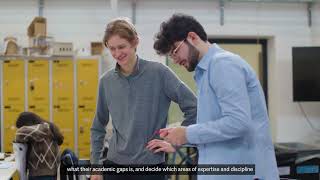
Progress in your journey to become a qualified architect, and produce innovative and integrated designs that address the challenges posed by a competitive and changing world.
The chance to specialise
You can choose from a series of optional modules to give you specialist grounding in one of our key built environment research areas.
Become an innovative designer
From contextual analysis, conception and implementation to evaluation, learn how innovative, inter-disciplinary design solutions arise from these different stages to address contemporary challenges.
A leading school of architecture
The School reflects the diversity and transdisciplinary nature of architecture, offering dedicated spaces for you to realise your design ideas.
Dedicated studio environments
Our bespoke facilities, located in a recently refurbished heritage building, include hybrid studios, workshops, digital fabrication and a Living Lab.
Access to leading expertise
Learn from our academic staff and experienced tutors from leading UK architectural practices with specialisms in a wide range of areas.
ARB accredited
Our two-year MArch in Architecture and the Built Environment will take you to an advanced level of architectural design in order to develop innovative design ideas and methods to address contemporary challenges. You’ll explore the full range of skills and specialist knowledge required to be an architect, while focusing on developing your personal and professional outlook. You will choose and develop a specialism in one of the school’s key built environment research areas.
Whilst the programme covers the full breadth of what is needed to become an architect, you will have the opportunity to shape your learning and focus on areas that are of particular interest to you. Your studies will be shaped by exposure to world-leading teacher-practitioners and researchers who will encourage you to develop new critical and creative approaches to design. You will be able to choose from a series of optional modules and studios, allowing you to engage with the school’s key research specialisms that will inform your design studies.
We encourage you to practice ‘grounded creativity;’ your design studies across both years will involve imaginative engagement with real-world issues and global challenges such as climate change and the UN’s sustainable development goals within localised contexts. You will further your understanding of how architecture is made and how it performs, reflecting on how your technological choices and the way these are integrated in the design process can support the wellbeing of present and future generations.
To prepare you for the demands of the architectural profession, we build on and extend your existing understandings of the historical, theoretical, cultural, political, and geographical dimensions of the architectural discipline. With a focus on innovation, professionalism and commercial awareness, you’ll be encouraged to reflect critically on the wider significance of personal decisions and actions as an architect.
The design studio is at the centre of our community, a place where you’ll mix with students, staff, and industry practitioners and other partners from outside the school to address ethical, global, climatic and professional issues. The studio environment provides the ideal space for you to take your studies in a direction that reflects your own interests, through a process of creativity and discovery. You’ll be encouraged to develop innovative knowledge by experimenting with design, take creative risks and expand your thinking.
Following graduation from the programme you will need to complete a Part 3 programme, for example our Postgraduate Diploma in Architecture: Professional Practice, if you intend to become a registered architect in the United Kingdom. Alternatively, the skills you develop on this module would provide you with a strong grounding to undertake a postgraduate research programme, leading to a PhD or MPhil.
Where you'll study
Welsh School of Architecture
We aim to make the world a better place through contextually sensitive, sustainable and beautiful architecture.
Admissions criteria
In order to be considered for an offer for this programme you will need to meet all of the entry requirements. We will be able to progress your application once the information listed in each of the points below is provided.
With your online application you will need to provide:
- A copy of your degree certificate and transcripts which show you have achieved a 2:1 honours degree in architecture from a UK institution recognised by the Royal Institute of British Architects/ (RIBA)Architects Registration Board (ARB) or a degree in architecture from a university overseas. If your degree certificate or result is pending, please upload any interim transcripts or provisional certificates.
- A copy of your IELTS certificate with an overall score of 6.5 with 5.5 in all subskills, or evidence of an accepted equivalent. Please include the date of your expected test if this qualification is pending. If you have alternative acceptable evidence, such as an undergraduate degree studied in the UK, please supply this in place of an IELTS.
- A personal statement in which you will need to explain why you want to study on the MArch at Cardiff University, what excites you about it, and how you think it will help you develop in your career. Please describe your particular architectural interests and what design/research agenda you hope to develop through the MArch course.
- A portfolio of your design work which may contain a balance of academic and professional work, but which should focus on final/graduation projects from your undergraduate architecture / architectural studies degree. Work produced within a practice context should be presented in a way that clearly identifies your individual contribution/ authorship. Other work may be included, for example, a design competition, life drawings or other creative outputs. We look for holistic approaches to design – projects that integrate analysis, conceptual thinking, creativity in spatial design and technical resolution. The portfolio should be uploaded to your application as a PDF document no larger than 10 MB in size.
Application Deadline
We allocate places on a first-come, first-served basis, so we recommend you apply as early as possible. Applications normally close at the end of August but may close sooner if all places are filled.
Selection process
We will review your application including your portfolio and if you meet all of the entry requirements, we will make you an offer.
Find out more about English language requirements.
Applicants who require a Student visa to study in the UK must present an acceptable English language qualification in order to meet UKVI (UK Visas and Immigration) requirements.
Criminal convictions
You are not required to complete a DBS (Disclosure Barring Service) check or provide a Certificate of Good Conduct to study this course.
If you are currently subject to any licence condition or monitoring restriction that could affect your ability to successfully complete your studies, you will be required to disclose your criminal record. Conditions include, but are not limited to:
- access to computers or devices that can store images
- use of internet and communication tools/devices
- curfews
- freedom of movement
- contact with people related to Cardiff University.
Course structure
The MArch Architecture and the Built Environment is a two-year, full-time programme, consisting of 120 credits in each year. All credits must be passed in each year to progress and complete the programme. Both years are spent full time on campus within the school’s dedicated studio environment.
You will undertake a different design project in each year where an emphasis is placed on integrating the knowledge you have learned in other parts of the programme. This will be supplemented by modules that help you to understand the contexts within which architecture sits and modules where you will reflect upon your learning, and how it relates to broader architectural practice.
The programme is structured to maximise opportunities for the development of your own interests. You will choose from a series of specialist modules led by subject experts from within the school who run our other postgraduate specialist courses. We also offer you a choice of design studios in year 2.
The modules shown are an example of the typical curriculum. Final modules will be published one month ahead of your programme starting.
Year one
Year One acts as a bridge between your prior studies in architecture, and the final design thesis that will be undertaken in year 2. The year consists of three key areas:
- Optional specialist modules where you choose from a series of modules in specialist areas researched in the school.
- A module which helps you to develop your skills in the area of Design Research, which will support your work in both year 1 and year 2 design modules
- An integrated design project where you work with your peers to apply what you have learned from other modules, bringing together the different specialisms that you have developed. This will be an opportunity for you to take risks and adopt a process of reflective learning and development as part of a collaborative and inclusive studio culture. In addition, you will be expected to show an ethical awareness of your actions.
A study visit will provide further opportunities to socialise with peers and tutors while engaging with real-world places, buildings, environments, communities incorporating context across all subject threads.
| Module title | Module code | Credits |
|---|---|---|
| Design Research Foundation | ART920 | 20 credits |
| Integrated Design Studio | ART921 | 60 credits |
| Module title | Module code | Credits |
|---|---|---|
| Enclosures in Environmental Building Design | ART018 | 20 credits |
| Sustainability frameworks at scales: society to materials | ART020 | 10 credits |
| Climate Comfort and Energy | ART041 | 20 credits |
| The Conservator's Role | ART501 | 20 credits |
| Tools of Interpretation | ART502 | 20 credits |
| Design Tools: Methods of Repair | ART505 | 20 credits |
| Introduction to 3D Modelling and Parametric Design | ART801 | 10 credits |
| Computational Form Finding | ART802 | 20 credits |
Year two
Year Two builds on the foundations from Year One, with a particular focus on design research tools, techniques, and methods.
The aim of the design thesis is to extend your knowledge of architectural design by developing a complex design proposal to resolve a particular design problem or issue. The development of this design unfolds collaboratively and individually over the course of the year in response to challenges within a selected design studio. Your studies will be supported by consultancies on architectural technology, contract law, procurement and sustainable building economics and you will use these to consider how, as an architect, you might provide value to clients, users and wider society.
You will be expected to critically evaluate your research and design decision making, reflecting upon the environmental, economic, social and professional implications in your work. You will be asked to submit a research-informed reflective commentary alongside your design project work.
Your work will be supported by contextual studies, where you focus on what we might learn from architectural precedents so we can respond to contemporary environmental, social, economic and professional contexts.
Year Two site, study and field trips will focus on your chosen studio and therefore studio brief and individual thesis. Trips may vary in location and length dependent on requirements within the UK or overseas.
Teaching in the areas of professional practice and ethics will provide you with the necessary competencies to work within the architecture profession.
| Module title | Module code | Credits |
|---|---|---|
| Design Research | ART910 | 20 credits |
| Design Thesis | ART911 | 60 credits |
| Professionalism, Project Delivery and Value | ART914 | 10 credits |
| Analysis of Precedents and Contexts | ART922 | 30 credits |
The University is committed to providing a wide range of module options where possible, but please be aware that whilst every effort is made to offer choice this may be limited in certain circumstances. This is due to the fact that some modules have limited numbers of places available, which are allocated on a first-come, first-served basis, while others have minimum student numbers required before they will run, to ensure that an appropriate quality of education can be delivered; some modules require students to have already taken particular subjects, and others are core or required on the programme you are taking. Modules may also be limited due to timetable clashes, and although the University works to minimise disruption to choice, we advise you to seek advice from the relevant School on the module choices available.
Learning and assessment
How will I be taught?
The MArch Architecture and Built Environment programme is focused on developing you as an ethical, innovative, creative, critical and curious learner and future architect.
Individual and small group tutorials and consultancies will provide feedback and feedforward on your work. Field trips and study visits provide an opportunity to experience architecture, places, and spaces first-hand, while site visits related to design projects provide opportunities to analyse contexts, culture and communities to inform your design studies. These are supplemented by lectures and workshops intended to address specific issues.
Independent study is critical to success in your studies and can involve iterative design processes to understand and/or critically solve a design problem, make connections between subjects, and prepare written material and presentations. You will be exposed to real-life contextual challenges and professional methods of addressing them, with the support of our institutional and professional partners.
How will I be assessed?
You will experience a range of different approaches to assessment, which allow you to demonstrate your learning across the subject and to gain valuable feedback which can be applied to future learning.
As with other creative subjects, much of your assessment will be through coursework. This may be subject specific such as a technical report or a portfolio of collated studies from one or more subjects. Through your design portfolio you will demonstrate your studio project work and include evidence of learning across the range of modules you have studied. Design Project Reviews, where you present your project work to a panel of reviewers. Reflective portfolios often related to the work developed in the design studio will assess personal insight on knowledge, observation and experiences across subjects and the discipline. You will receive regular feedback on your work in a variety of forms including written and oral feedback from your tutors as well as feedback provided by your peers. Design reviews, weekly tutorials and interim assessments provide valuable feedback to inform the development of your work.
How will I be supported?
You will be supported in a number of ways throughout your learning experience. We host regular year meetings and student-staff panels for you and the rest of your cohort to discuss year-wide matters, and for us to listen and respond to your feedback.
Module level support is provided by module leaders, and support for design projects and dissertations is provided by an allocated Tutor.
You will be allocated a personal tutor who you will meet with to reflect on your progress and development, and the University also has a student-led mentoring service to support you through your studies.
You will have access to all course materials, including lecture recordings, handouts, details of all assessments, assessment criteria and links to digital resources, via the Cardiff University Virtual Learning Environment.
Beyond the School, the University offers a range of support services to help you manage your study, wellbeing, finances and career development. Student Futures can support you to develop your employability and enterprise skills, find work experience and undertake study, work and volunteering opportunities abroad. The Health and Wellbeing service provides information, support and events to help you manage your emotional, mental and physical health and there is help available to support you with managing your money, including information on tuition fees and funding options. You can access a range of support related to developing your study skills and the Students Union also provides a variety of services, including access to events, societies and clubs.
What skills will I practise and develop?
The Learning Outcomes for this Programme describe what you will achieve by the end of your programme at Cardiff University and identify the knowledge and skills that you will develop. They will also help you to understand what is expected of you.
On successful completion of your Programme you will be able to:
Knowledge & Understanding:
- Integrate knowledge of sustainable construction and building performance into design projects.
- Appreciate the implications of architectural design on climate change, biodiversity, health and safety and the wellbeing for future generations.
- Critically evaluate architectural precedents in order to inform design thinking.
- Recognise the cost and value of design decisions across the life cycle of a project and for its stakeholders.
- Explore in depth a specialist subject area from within the school's research portfolio
Intellectual Skills:
- Design complex, sustainable and well resolved projects for and within the built environment developed from an original response to and critical awareness of contextual issues and a related subject specialism.
- Develop a creative and rigorous design brief in response to research questions or practice challenges.
- Interrogate and establish appropriate design research methodologies and techniques to explore design problems systematically.
- Propose and develop creative ideas and strategies, balancing constraints and opportunities from diverse, sometimes contradictory, factors.
- Formulate a research argument to establish a critical position within the field of architecture and the chosen subject specialism
- Integrate the knowledge and understanding from a chosen specialist area into design project work
Professional Practical Skills:
- Show commitment to social, political, environmental and economic factors within professional contexts while preparing architectural designs.
- Design projects that address human needs, inclusivity, user experience, the relationship between buildings, spaces, and their context and relationship between people and the environment
- Critically evaluate design strategies and solutions that respond to physical, spatial and environmental comfort
- Address ethical challenges in architectural design, research, and practice, making informed and responsible decisions.
- Evaluate the architect’s role in collaborative professional relationships, considering practice management, legal, and regulatory processes.
Transferable/Key Skills:
- Communicate research, ideas, and designs effectively through appropriate representation and presentation methods for diverse audiences.
- Present design, technical, theoretical and/ or historical research-led positions using verbal, visual, and written communication methods appropriate to the audience.
- Engage in reflective practices to develop personal, professional, and intellectual capacities.
- Apply transferable skills, including teamwork, independent work, resource management, critical thinking, entrepreneurship, and respect for diverse opinions.
Tuition fees for 2027 entry
Your tuition fees and how you pay them will depend on your fee status. Your fee status could be home, island or overseas.
Learn how we decide your fee status
Fees for home status
| Year | Tuition fee 1 | Deposit |
|---|---|---|
| Year one | £9,790 | None |
| Year two | £9,790 | None |
1 In the event that the Welsh government increases the tuition fee cap between acceptance of your offer and the start of the academic year, the University will write to you to inform you of any changes to the tuition fees payable for your programme and, where relevant, give you the opportunity to withdraw without penalty should you no longer wish to take up your place.
If you have been classified as a home student and qualify for the government-regulated undergraduate tuition fee, you will be charged a single tuition fee for each academic year. The University’s policy is to charge the maximum regulated fee to reflect increased costs of delivery and maintain a high-quality student experience. Tuition fees may therefore increase in line with any uplift determined by the Welsh government by law or policy in the second and subsequent years of your course. Where applicable we will notify you of any change in tuition fee by the end of June in the academic year before the one in which the fee will increase. Should you choose to change your programme of study or commence a new programme of study, you will be charged the same fee as new students entering that programme.
Fees for overseas status
| Year | Tuition fee | Deposit |
|---|---|---|
| Year one | £31,700 | £3,000 |
| Year two | £31,700 | None |
More information about tuition fees and deposits, including for part-time and continuing students.
Financial support
Financial support may be available to individuals who meet certain criteria. For more information visit our funding section. Please note that these sources of financial support are limited and therefore not everyone who meets the criteria are guaranteed to receive the support.
Additional costs
We will cover the costs of all essential aspects of study, including essential printing and plotting, software licenses and materials for basic and required model making. You may want to buy additional model making materials beyond what is deemed essential.
We also provide funding to cover the essential elements of study trips and site or field visits. However, sometimes optional modules or projects may incur additional costs beyond what the school covers. We will make sure these choices are always optional, with alternatives available without the higher costs.
Will I need any specific equipment to study this course/programme?
You will need basic stationery and materials for drawing and sketching throughout the course.
We provide a range of high-spec PCs for students to access, but we do recommend you acquire a laptop computer to be able to access digital learning materials and run specific software.
You might also find it useful to have a camera for photographing models and other work and for recording sites and field trips, and a tablet or phone for recording sound or study-related activities.
Living costs
We’re based in one of the UK’s most affordable cities. Find out more about living costs in Cardiff.
Funding
Career prospects
Our grounded approach to creativity and design is the ideal foundation for employment at a more advanced and competent level.
The MArch in Architecture and the Built Environment encourages you to become an independent, innovative and critical thinker. You will be well positioned to influence the future direction of the industry and your career. Previous graduates of the School have successfully formed practices, not for profit community focused organisations, charitable foundations and professional collaborative networks within the field of architecture.
We’ll also provide you with opportunities to speak with and learn from active architects and industry consultants, many of whom regularly advertise for graduate positions in the school. This may happen through your design studio project work, where in the past we have run projects that require students to engage with communities, charities and representatives from public and private sector bodies.
Graduate prospects for students on our programmes are strong, with the majority of our graduates going on to work in the architectural profession and pursuing successful careers. It’s also a good foundation for entry into other creative and design disciplines, with some of our previous graduates going on to roles in web design, product design, automotive design, set design, graphic design or illustration, architectural journalism, photography, architectural history and craft/maker-based disciplines. Previous graduates have also embarked on further study including research degrees.
We’re committed to ensuring you develop the six graduate attributes; skills that the Cardiff University has identified are key skills valued by industry and employers. As a Cardiff graduate you will be:
- Collaborative
- An effective communicator
- Ethically, socially, and environmentally aware
- An independent and critical thinker
- Innovative, enterprising, and commercially aware
- Reflective and resilient
Our emphasis on collaborative and ethical practice will encourage you to develop a personal stance on the impact and influence of architecture on a global society.
Next steps
Open Day visits
Register for information about our upcoming dates.Make an enquiry
Contact us for more information about this course.International
Learn more about our truly global university.Discover more
HESA Data: Copyright Higher Education Statistics Agency Limited 2021. The Higher Education Statistics Agency Limited cannot accept responsibility for any inferences or conclusions derived by third parties from its data. Data is from the latest Graduate Outcomes Survey 2019/20, published by HESA in June 2022.
