Dr Karen Reed
Research
Mouse models of human diseases facilitate an understanding of the mechanisms that contribute to the initiation, establishment and progression of diseases such as cancer in human.
My current research utilises a number of clinically relevant, transgenic mouse models of cancer (principally intestinal and liver cancer).
The (APC) tumour suppressor protein is well characterised as a key regulator of Wnt signalling, and elevation of the levels of b-catenin is a known consequence of loss of APC function. Mutations in the APC gene are associated with both familial and sporadic colon cancer pathogenesis and links with other cancers including hepatocellular carcinoma and renal cancer are reported.
The conditional deletion of Apc in the adult intestine or liver quickly results in the neoplasm. Transcriptome analysis using affymetrix microarrays has identified a number of transcripts that are differentially regulated following the conditional loss of Apc in this system and the data generated has been used to establish some of the critical molecular events that contribute to the initiation and progression of tumourigenesis (e.g. Sansom et al 2004+2007, Reed et al 2004, 2006+2008).
My objective is to develop my own research group, and I am committed to understanding the mechanisms of normal gene regulation and how misregulation of these mechanisms contributes to the development of neoplasia.
I see the importance of imprinted genes (the expression of which is normally strictly regulated, but becomes deregulated at the earliest stages of neoplasia) as a model to investigate factors affecting epigenetic control and the role these factors play in tumourigenesis. My research history has given me excellent experience, and uniquely equipped me with expertise in the relevant fields of epigenetic regulation and murine models of cancer.
Outreach activities
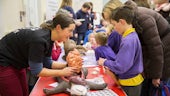
My first involvement in public engagement was through the Beacons for Wales Researchers in Residence scheme, but I have since participated in several activities; Some (e.g, the Beacons for Wales $1000 genome project in Park Prison, Bridgend or the "Learn about Life" events in Cardiff School of Biosciences) have been pre-organised by others, while other activities I have initiated and organised myself (e.g. school visits to Goytre Fawr Primary school and Archdeacon John Lewis Primary school). I have developed a highly successful interactive activity demonstrating how the polymerase chain reaction works which I have run as a 3 hour workshop for visiting pre-GCSE pupils who were participating in a Hands-On Science Summer Residential course.
Awards and Funding obtained
Tenovus PhD studentship to support Charmmy Ka Ian Lio 2011
The Biochemical Society Scientific Outreach Grant, 2011
The Nuffield Foundation Science Bursary, 2011
The Royal Society Partnership grant, 2010
The Nuffield Foundation Science Bursary, 2010
The Nuffield Foundation Undergraduate Research Bursary, 2008
BACR meeting bursary, 2008
BACR Hamilton-Fairley Young Investigator Award, 2006
Students supervised
Charmmy Ka Ian Lio 1st year PhD student - Tenovus Funded.
Madeleine Young 2st year PhD student.
I mentored Dr Paul Shaw during his PhD (graduated 2010)
I have organised and supervised projects for the summer students:
Adam Lynch (voluntary) 2011
James Lamb (Nuffield Foundation Bursary A level student) 2011
James Moggridge (Nuffield Foundation Bursary A level student) 2011
Ben Hopkins (Nuffield Foundation Bursary A level student) 2010
James Platt (Nuffield Foundation Undergraduate Bursary student) 2008
I have organised and supervised projects for the following final year undergraduate students:
Scott Hart 2011
Nesibe-princess Gemici 2010
Adam Carrico 2009
Gokcen Ilktac 2008
David Hunt 2007
Ryan Russell 2006
Bethan Medina 2005
Collaborators
Dr Owen Sansom, Cancer Research UK Beatson Laboratories, Glasgow.
Dr David Tosh and Dr Zoe Burke, Centre for Regenerative Medicine, Department of Biology and Biochemistry, University of Bath.
Dr John Jenkins, Gastroenterology Research Unit, The University of Liverpool.
Dr David Bell, School of Biology, University of Nottingham.
Dr Ros John, Cardiff School of Biosciences
Dr Vladimir Buchman, Cardiff School of Biosciences
Presentations
NCRI (national cancer research Institute) cancer conference 6-9 Nov 2011, BT Convention Centre, Liverpool, UK
"The impact of APC2 on somatic stem cells and tumourigenesis"
Karen Reed, Carl Daly, Paul Shaw, Alan Clarke
Warwick 2008 Genes and Cancer Meeting, December 8-10, 2008
“Beta-catenin deficiency, but not Myc deletion, suppresses the immediate phenotypes of Apc loss in the liver”
Karen R Reed*, Dimitris Athineos*, Valerie S Meniel*, Julie A Wilkins, Rachel A Ridgway, Zoé D. Burke, Vanesa Muncan, Alan R Clarke, Owen J Sansom
NCRI (national cancer research Institute) cancer conference 8-11Oct 2006, The ICC, Birmingham, UK
A BACR/Gordon Hamilton-fairly young investigator award “P53 status does not affect the early phenotype seen following the conditional loss of APC.”
Reed KR, Sansom OJ, Meniel V, Marsh V, Clarke AR
Warwick 2004 Genes and Cancer Meeting, December 13-15, 2004
“PPARd deficiency does not modify APC mediated tumourigenesis”
Karen R. Reed, Anthony J. Hayes, Owen J. Sansom, Hannah Brinkman, Jeffrey Peters, Alan R. Clarke
Imprinting and growth congress 2002. 11-13 April 2002, London.
“The Minute mutation and a comparative genomics approach for the isolation of enhancers controlling Igf2 expression.”
Davies K, Smith P, dean, W, Bowden L, Sasaki H, Cattanach B, Reik W.
The International Genomic Imprinting Meeting 24-26 Aug 1999, Dublin
ORAL Presentation: “The radiation-induced mouse mutation minute (Mnt) affects the mesoderm enhancer for IGF2 and methylation of H19.”
Davies K, Bowden L, Rasberry C, Cattanach B, Reik W.