Clinical Optometry (MSc)
- Duration: 50 weeks
- Mode: Full time

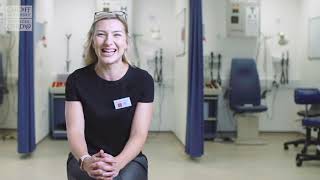
Open day
Find out more about studying here as a postgraduate at our next Open Day.
Why study this course
The MSc Clinical Optometry is designed for optometrists seeking to enhance their clinical practice through evidence-based training, to broaden their clinical knowledge and skills appropriate for a rapidly expanding profession.
Blended learning
Flexibility to join lectures and access learning material remotely, to support your in-person practical clinical teaching sessions.
Weekly clinical sessions
Each week you’ll attend in-person guided clinics. You’ll also be able to attend NHS clinics in a variety of clinical specialities.
Specialist clinical qualifications
Modules on this programme are accredited by the College of Optometrists to award higher qualifications in low vision, glaucoma and medical retina.
Studying alongside other international and UK ophthalmic professionals, you will have the opportunity to develop advanced clinical skills and rotate through, and engage with, our on-site professional clinics within our custom-designed ophthalmic teaching clinics.
You’ll explore and analyse the changing needs of patients and clinical practice and develop the skills to deliver specialist areas of care to meet patient needs. Our programme underpins your expertise in a range of key optometric areas including glaucoma, medical retina and primary eye care. There is also optionality for you to tailor your study and work towards clinical sub-specialty in one or more of the following areas: low vision, acute eye care and contact lenses.
Please note that this programme is not an optometry conversion course. It does not lead to full professional registration with the General Optical Council (GOC), and it does not qualify you to practice in the UK. However, the General Optical Council may consider this qualification as contributing towards equivalence against the UK standards of competence.
We're committed to delivering programmes that are innovative and relevant, providing the best learning outcomes and career prospects for our students. In light of this, we're currently reviewing some elements of this programme. As such, the details shown are subject to change and indicative only. You can still apply now. We'll update this page and contact all offer holders when the review is complete to confirm any changes.
Where you'll study
School of Optometry and Vision Sciences
Our students benefit from hands on experience, outstanding optometry facilities and involvement from our internationally renowned staff.
Admissions criteria
In order to be considered for an offer for this programme you will need to meet all of the entry requirements. Your application will not be progressed if the information and evidence listed is not provided.
If you are registered with the GOC, with your online application you will need to provide:
1. Evidence of full GOC registration (UK students). If you are registered with the GOC, you must provide your GOC number in the Membership of Professional Bodies section of the application form.
2. A personal statement which clearly states the modules you intend to study and when you wish to start.
If you are not registered with the GOC, with your online application you will need to provide:
1. A copy of your certificate and transcripts which show you have achieved an honours degree in Optometry or a professional optometric qualification. If your certificate or result is pending, please upload any interim transcripts or provisional certificates.
2. A copy of your IELTS certificate with an overall score of 6.5 with 5.5 in all subskills, or evidence of an accepted equivalent. Please include the date of your expected test if this qualification is pending. If you have alternative acceptable evidence, such as an undergraduate degree studied in the UK, please supply this in place of an IELTS.
3. A written professional reference which is signed, dated, and supplied on the University’s reference form or headed paper. The reference will need to comment specifically on your slit-lamp technique to assess the anterior eye and slit-lamp Volk binocular indirect ophthalmoscopy (BIO) technique to assess the retina. If it is not possible to provide a professional reference, academic references will be considered.
4. Submit a 500-word personal statement that includes the following: a summary of your academic background in optometry, including any notable achievements or research experience; an overview of your clinical experience, highlighting the settings you have worked in and the scope of your responsibilities; a description of your proficiency in key clinical skills, including:
- Slit lamp examination of the anterior eye, including cornea and anterior chamber
- Assessing the features of the posterior fundus using slit lamp Volk BIO technique
- Goldmann applanation tonometry
- Visual field and OCT assessment with basic interpretation
- Retinoscopy
Application Deadline
The deadline for application is mid-July, to provide time to interview applicants and apply for visas prior to the start of the programme. However, we allocate places on a first-come, first-served basis, so we recommend you apply as early as possible, as places can often be full by the end of April.
Selection process
As the scope of optometric practice varies considerably around the world, interviews may be held with non-UK optometrists, in person or online, to ensure practitioners have the relevant clinical skills required to undertake this course. You may be required to have particular clinical skills that will be confirmed through references and interview and/or may need to complete primary care modules prior to completing other modules.
Other programme information
Please see the module list for more information on the range of optional modules we offer. There is a very high demand for certain modules and places are allocated on the basis of date of application. If a module is full, wherever possible, we will offer the applicant a place on the next available occurrence.
Modules that are accredited by the College of Optometrists must be completed in order i.e. students must achieve the College’s Professional certificate before selecting the module accredited for the College’s Higher Certificate and must achieve the College’s Higher Certificate before selecting to the module accredited for the College’s Diploma.
Find out more about English language requirements.
Applicants who require a Student visa to study in the UK must present an acceptable English language qualification in order to meet UKVI (UK Visas and Immigration) requirements.
Criminal convictions
You are not required to complete a DBS (Disclosure Barring Service) check or provide a Certificate of Good Conduct to study this course.
If you are currently subject to any licence condition or monitoring restriction that could affect your ability to successfully complete your studies, you will be required to disclose your criminal record. Conditions include, but are not limited to:
- access to computers or devices that can store images
- use of internet and communication tools/devices
- curfews
- freedom of movement
- contact with people related to Cardiff University.
Course structure
The MSc Clinical Optometry is a one-year full time programme that commences at the end of September each year. For the first nine months of the programme, you’ll focus on the taught component, which includes core modules on research skills, along with essential optometry and clinical skills.
After successful completion of the taught stage, you can progress onto the research project. Typical research themes include (i) neuroscience and ageing, (ii) stem cells, regeneration and repair (iii) visual and ocular development, (iv) ocular disease and management.
The modules shown are an example of the typical curriculum. Final modules will be published one month ahead of your programme starting.
The MSc Clinical Optometry comprises of a taught stage and a dissertation stage.
The taught stage runs from September to June and is made up of:
- 70 credits of core modules. These modules create the framework for the MSc, teaching the essential theory and skills required, developing your practical and clinical skills through the year and preparing you to plan and research the final project.
- 50 credits of specialist clinical modules. These include the opportunity to complete professional qualifications which are accredited by the College of Optometrists, such as Professional Certificates in Medical Retina, Glaucoma or Low Vision.
The dissertation stage begins after successful completion of the taught stage. During the dissertation stage, you will complete a 60-credit research project over 11 weeks.
You will be able to choose from themes such as (i) neuroscience and ageing, (ii) stem cells, regeneration and repair (iii) visual and ocular development and (iv) ocular disease and management.
| Module title | Module code | Credits |
|---|---|---|
| Low Vision 1: Theory | OPT001 | 10 credits |
| Acute Eye Care in Optometry 1 | OPT004 | 10 credits |
| Study and Research Skills for Eye Care Professionals | OPT008 | 10 credits |
| Glaucoma Foundation | OPT009 | 10 credits |
| Essential Eye Care for Optometrists | OPT050 | 30 credits |
| Research Project | OPT063 | 60 credits |
| Module title | Module code | Credits |
|---|---|---|
| Low Vision 2: Practical | OPT002 | 10 credits |
| Acute Eye Care in Optometry 2 | OPT005 | 10 credits |
| Glaucoma 1 | OPT010 | 10 credits |
| Medical Retina | OPT025 | 20 credits |
| Contact Lenses 1 | OPT040 | 10 credits |
The University is committed to providing a wide range of module options where possible, but please be aware that whilst every effort is made to offer choice this may be limited in certain circumstances. This is due to the fact that some modules have limited numbers of places available, which are allocated on a first-come, first-served basis, while others have minimum student numbers required before they will run, to ensure that an appropriate quality of education can be delivered; some modules require students to have already taken particular subjects, and others are core or required on the programme you are taking. Modules may also be limited due to timetable clashes, and although the University works to minimise disruption to choice, we advise you to seek advice from the relevant School on the module choices available.
Learning and assessment
How will I be taught?
This programme provides a blend of self-directed online learning and guided in-person practical clinical teaching.
You will attend weekly in-person clinical skills sessions throughout the academic year. In addition, you will also have the opportunity to attend and observe professional clinics in a variety of specialties, which may include low vision, glaucoma and medical retina.
Lectures are provided online in advance for you to work through at your own pace, with some modules requiring attendance at in-person teaching and assessment days.
Throughout all modules there is a particular emphasis on identifying your own specific learning needs to direct your independent study and to ensure the module is relevant to your own practice. Application of knowledge and skills in practice is the core of each module.
How will I be assessed?
Assessments measure professional, academic and/or clinical practice. Many modules include formative assessments (assessments which do not count towards the module mark) which are intended to provide you with feedback and an indication of your progress, to support your development.
Methods of summative assessment (assessments which count towards the module mark) vary depending upon the module and their specific learning outcomes. Methods include portfolios, oral presentations, objective structured clinical examination, written assignments such as posters, patient management problems, reflective assignments and analytical reviews. Where there is an experiential practice component of the module, an assessment of your practice will be completed by an accredited tutor. These tutors are trained, supported, and guided by the University academic staff.
We will provide you with feedback on your work in a variety of formats. These will include oral feedback and electronic written feedback on assessed coursework. The opportunity to understand and use feedback constructively will also be provided through meeting with your personal tutor. During your experiential practice you will be supported by an accredited tutor who will provide verbal and written feedback on your practice.
How will I be supported?
You will find lots of useful course materials on Learning Central, which will complement your independent study. You’ll also receive supervision during your Research Project and be allocated a personal tutor who will support you throughout your studies.
Our dedicated Student Support Teams will also be on hand to support you with all aspects of your student life, from health and wellbeing to career planning, finances, and accommodation.
What skills will I practise and develop?
After fully engaging with this course, you should be able to:
Knowledge & Understanding:
- Evidence a comprehensive knowledge of ocular diseases, treatment strategies and research governance in the healthcare environment.
- Develop a critical understanding of appropriate research methods in clinical optometry.
- Exhibit a systematic understanding of ethical and governance issues and frameworks in clinical optometry practice and research.
- Convey a comprehensive understanding of the factors affecting health inequalities and social determinants of health.
Intellectual Skills:
- Apply critical thinking, problem solving and reasoning skills to deliver effective patient care and medicine management.
- Critically evaluate and appraise skills when making decisions, both within and beyond the scope of guidelines.
- Independently design and conduct a research project, using relevant research methodologies to investigate a clinical optometry-related question.
Professional Practical Skills:
- Cultivate and manage safe and effective professional practice in the healthcare environment.
- Convey personal responsibility for your actions and decisions in a wide range of clinical and non-clinical contexts.
- Critically reflect and evaluate learning to inform application in the clinical workplace.
Transferable/Key Skills:
- Enhance effective communication skills to deliver balanced and appropriate information to different audiences, by a range of different modes.
- Demonstrate digital capabilities relevant to the professional role.
- Foster collaborative working with allied health professionals.
- Critically evaluate a range of evidence-based principles, approaches and techniques to be applied in practice.
Tuition fees for 2027 entry
Your tuition fees and how you pay them will depend on your fee status. Your fee status could be home, island or overseas.
Learn how we decide your fee status
Fees for home status
| Year | Tuition fee | Deposit |
|---|---|---|
| Year one | £13,140 | None |
Fees for overseas status
| Year | Tuition fee | Deposit |
|---|---|---|
| Year one | £24,660 | £3,000 |
More information about tuition fees and deposits, including for part-time and continuing students.
Financial support
Financial support may be available to individuals who meet certain criteria. For more information visit our funding section. Please note that these sources of financial support are limited and therefore not everyone who meets the criteria are guaranteed to receive the support.
Additional costs
You will need to cover your living costs including accommodation and food whilst in Cardiff as well as the cost of travel to and from Cardiff.
Will I need any specific equipment to study this course/programme?
No – all equipment will be provided.
Living costs
We’re based in one of the UK’s most affordable cities. Find out more about living costs in Cardiff.
Funding
Career prospects
The programme enables you to continue the education and training needs of the modern eye care professional, providing advanced knowledge and facilitating understanding in this rapidly expanding field of healthcare.
Weekly in-person guided clinic sessions and rotation through our on-site professional clinics provides experience in UK clinical settings to advance your knowledge and specialist clinical skills for ophthalmic practice roles and models of care delivery. By completing modules in specialist areas in optometric practice, you will focus on the next steps of your career and your personal development: Depending on which modules are chosen, it may act as assurance that you are competent to work in specialist clinics as outlined in the Royal College of Ophthalmologists and College of Optometrists Joint Competency Framework for Allied Health Professionals. For example, the Medical Retina and Glaucoma module aligns with the Medical Retina and Glaucoma Competency Frameworks respectively.
Please note that this programme does not lead to full professional registration with the General Optical Council (GOC), and it does not serve as a conversion course allowing you to practice as an Optometrist. However, the General Optical Council may consider this qualification as contributing towards equivalence against the UK standards of competence. You will need to contact the GOC directly for advice.
Next steps
Open Day visits
Register for information about our upcoming dates.Make an enquiry
Contact us for more information about this course.International
Learn more about our truly global university.Other course options
Discover more
Related searches: Optometry, Vision sciences
HESA Data: Copyright Higher Education Statistics Agency Limited 2021. The Higher Education Statistics Agency Limited cannot accept responsibility for any inferences or conclusions derived by third parties from its data. Data is from the latest Graduate Outcomes Survey 2019/20, published by HESA in June 2022.
