Policy

Academic Promotion Procedure

Cardiff University
sbarc|spark, Maindy Road, Cathays, Cardiff, CF24 4HQ
  • Academic Promotions
  • Tel: +44 (0)29 2087 6555
  • Email: academicpromotions@cardiff.ac.uk

1. Eligibility

1.1. Academic promotion enables advancement to Senior Lecturer, Reader and Personal Chair (Professor) for staff on the Teaching and Research and Teaching and Scholarship career pathways and to Senior Research Fellow, Principal Research Fellow and Professorial Research Fellow for staff on the Research career pathway.

1.2. All academic staff on the Teaching and Research, Teaching and Scholarship and Research career pathways (including clinical equivalents) are eligible to apply.

1.3. Clinical staff are eligible to apply for academic promotion. Clinical staff will be assessed on their academic contribution to the University at the same quality threshold as non-clinical staff. This may be informed by the translation of clinical practice to academic activity. Adjustments for sessional commitments will be made in assessing the volume of outputs. Details of sessional commitments to both the University and the relevant Trust should be outlined in the application. Clinical duties will be considered only when undertaken for the University and connected to academic work.

1.4.  Applicants are only eligible for promotion within their existing career pathway. Staff wishing to move between career pathways should refer to the Procedure for a Change of Career Pathway. Occasionally, it may be appropriate for a member of professional services staff to move to an academic career pathway. The titles awarded through academic promotion are recognition of the holder’s academic standing. Professional services staff applying for a change of career pathway must also demonstrate their academic standing through the academic promotions process for these titles to be awarded.

1.5. Staff who have moved career pathways for a time-limited period (e.g. to take up a research fellowship) should apply on the basis of their substantive role and career pathway. In assessing the application, consideration will be given to the impact of the temporary career pathway change on the profile of evidence presented. Any award will be applied to both the substantive and time-limited posts.

1.6. Staff subject to probation are eligible to apply for academic promotion. To be successful, applicants will need to meet the criteria at the level applied for.

1.7. Staff are encouraged to apply for academic promotion when they meet the criteria for each level. It is expected that staff will progress sequentially through each career stage (e.g. from Lecturer to Senior Lecturer). Promotion to a level higher than the next career stage (e.g. from Lecturer to Reader) may be awarded where applicants clearly demonstrate significant evidence of the appropriate level of performance which is likely to be sustained.

1.8. A member of staff subject to a formal warning is not eligible to apply for academic promotion in the 12 months from the date of that warning. If at any time during the promotion process a member of staff is subject to a disciplinary investigation, the promotion process will be paused pending the outcome of the investigation.

2. Equity, Diversity, Inclusion and Anti-racism

2.1. Cardiff University is committed to supporting, developing and promoting equity, diversity, inclusion and anti-racism in all its practices and activities and aims to establish an inclusive culture free from discrimination and based upon the values of dignity, courtesy and respect. We are committed to eliminating discrimination and advancing equity on the grounds of age, disability, gender, gender identity, marriage and civil partnership, pregnancy and maternity, race, religion or belief (including lack of belief), sexual orientation and Welsh language and to fostering good relations between different groups. The University values diversity and recognises that the institution is greatly enhanced by the disparate range of backgrounds, experiences, views, beliefs and cultures represented within its staff and student populations. The institution aims to embrace diversity in all its activities and proudly acknowledges that variety and difference are intrinsic to the wellbeing and future development of our University.

2.2. In Higher Education, staff who are female, from an ethnic minority background or who have a disability are underrepresented in senior academic roles. Underrepresentation is often greatest among staff who share more than one of these protected characteristics (intersectionality). Staff who identify with these groups are particularly encouraged to apply. The composition of Academic Promotions Committee, School and College Promotion Panels will, wherever practicable, be representative of the wider academic community in respect of career pathways and protected characteristics. Equity, diversity and inclusion data will be anonymously reported to Academic Promotions Committee on the conclusion of each promotions round, and to other bodies as appropriate. This will be used to monitor the fairness of the scheme and inform future developments.

3. Individual circumstances

3.1. The Academic Promotion Procedure applies equally to all eligible staff. This includes staff on both open-ended, open-ended with relevant factor and fixed-term contracts. An applicant’s contractual arrangements (e.g. full-time, part-time, job-sharing, clinical responsibilities) and any personal, familial or non-academic circumstances that may have impacted an applicant's professional career will be taken into account in assessing the volume of activity. While there shall be no dilution in quality, account will be taken of the quantity of work.

3.2. Applicants are encouraged to disclose in their application any factors that have affected their career profile. These factors may include, but are not limited to:

  • flexible working arrangements (e.g. part-time working, career breaks, semester/ term-time working, job-sharing)
  • pregnancy, maternity leave, paternity/ partner leave, shared parental leave, adoption and surrogacy, special guardianship, caring responsibilities
  • disability, ill health or injury
  • mental health circumstances
  • impact of transition for the trans and non-binary community
  • personal, familial, or other non-academic circumstances that have restricted or delayed the applicant's professional career

3.3. Applicants preferring to keep specific details of such factors confidential should focus on their impact. Retrospective disclosures will not be considered, unless circumstances come to light which were not known by the applicant at the time of submission. This information will be used to inform the academic promotions process only and will not be used for any other purpose including as a disclosure to inform or update staff records.

4. Responsible research assessment

4.1. Cardiff University is a signatory to the San Francisco Declaration on Research Assessment (DORA), which means that in recruitment and promotion decisions we evaluate applicants on the quality of their research, not journal-based metrics or the identity of the journal/ output in which the research is published. More information is available on the University’s webpages on responsible research assessment.

4.2. In assessing research outputs, while there will be a balance between quality and quantity, priority will be given to the quality of outputs. We will assess research outputs primarily through peer review. The scientific content of a paper is more important than publication metrics or the reputation of the journal. We will consider the value and impact of all research outputs (including datasets and software) and be attentive to a broad range of impact measures, including qualitative indicators of research impact, such as influence on policy and practice. Similarly, collaboration, partnership and interdisciplinary working is encouraged as an integral part of building a positive research culture.

5. Application process

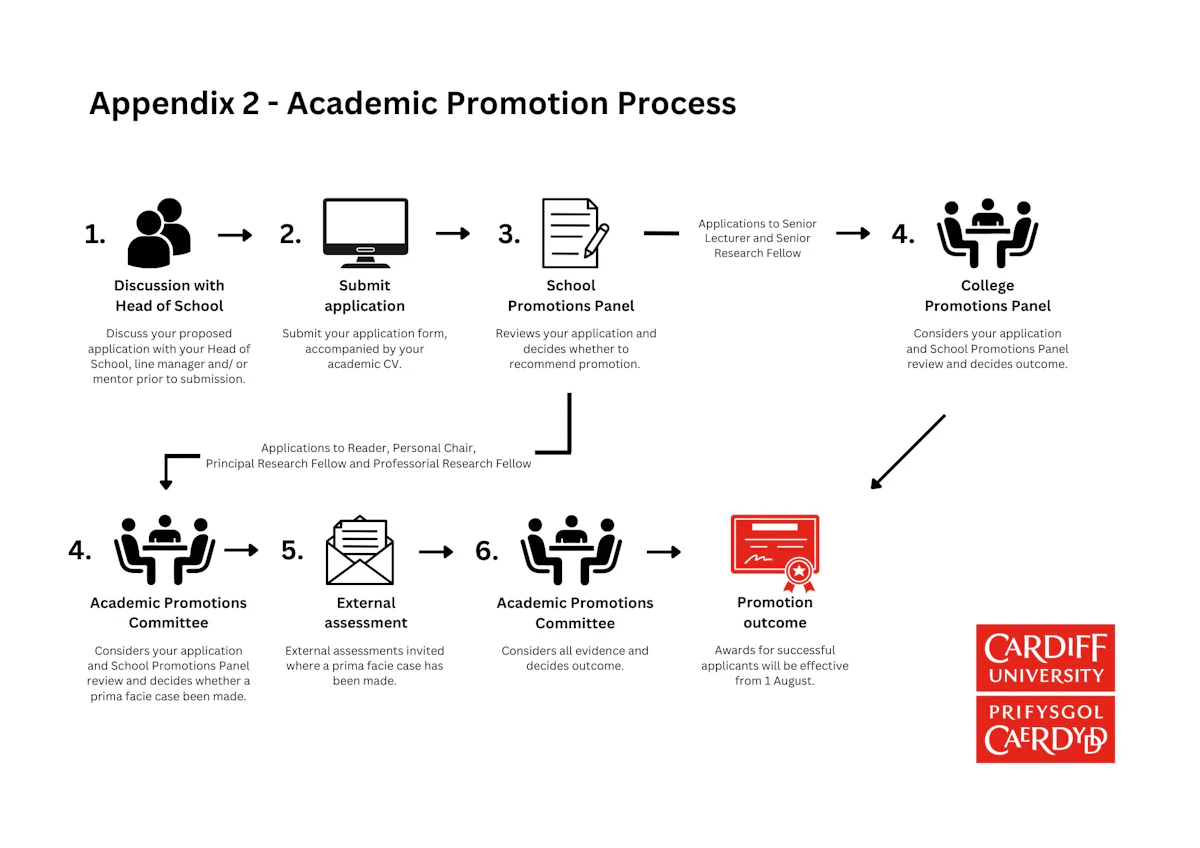
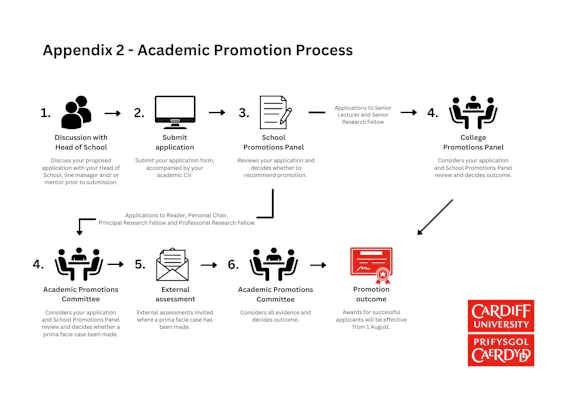
Appendix 2 illustrates the main stages of the academic promotions process. These are described in more detail below.

5.1. Discussion with Head of School

.1. Applicants are encouraged to discuss their application with their line manager and Head of School (if different) prior to submission.

.2. Academic promotion exists within a wider framework of support for personal and professional development. Wider support for academic and career development is encouraged prior to submission as part of an ongoing, supportive working environment and it is expected that colleagues will have a formal opportunity to discuss their academic and career development as part of their annual Performance Development Review (PDR).

5.2. Application submission

.1. Applications must be submitted to academicpromotions@cardiff.ac.uk by Friday 30 January 2026. Applications will be accepted after the deadline only in exceptional circumstances and with prior agreement from the Chair of the Academic Promotions Committee. Achievements that post-date the application deadline cannot subsequently be taken into account.

.2. Applications must be submitted using the application form and accompanied by an academic CV. CVs must be no more than 5 A4 pages. Applications are welcome in Welsh or English.

.3. Academic careers take many forms and prior roles will inevitably provide a wealth of diverse knowledge, skills and experience that shape your current practice. The assessment of applications will be based primarily on your contributions since appointment to your current role (or since submission of your last successful promotion application). You are therefore encouraged to focus on your most recent achievements. Industry, professional practice and other experience gained beyond academia are valued and recognised in terms of how this experience is applied within your current role.

5.3. School Promotions Panel

.1. School Promotions Panel will review each application against the criteria and decide whether to recommend promotion. Head of School or nominee to write a report summarising the School Promotions Panel’s evidence-based assessment of the case. School Promotions Panel may recommend promotion to a level either above or below the level applied for where they consider it appropriate to do so based on their evidence-based assessment against the criteria.

.2. Applicants will be given the opportunity to amend their application where this is necessary to ensure technical compliance with the procedure.

.3. Head of School or nominee will share their report with the applicant. Where an application is believed to be premature, in addition to sharing the report, the Head of School or nominee will meet with the applicant for a future-focused discussion to provide advice and guidance on future development. Applicants can request their case be considered by their College Promotions Panel or Academic Promotions Committee (as appropriate) irrespective of whether the School Promotions Panel is supportive of the case.

.4. Applications for promotion to Senior Lecturer or Senior Research Fellow will be referred to the College Promotions Panel (see section 5.4). Applications for promotion to Reader, Personal Chair, Principal Research Fellow or Professorial Research Fellow will  be referred to the University Academic Promotions Committee (see section 5.5).

5.4. College Promotions Panel (for applications for promotion to Senior Lecturer or Senior Research Fellow)

.1. College Promotions Panel will  review all applications for Senior Lecturer and Senior Research Fellow and decide final outcomes.

.2. Unsuccessful applicants will be provided with written feedback as outlined in section 7. Unsuccessful applicants are entitled to appeal as outlined in section 8.

.3. College Promotions Panels will refer a case to Academic Promotions Committee where it considers promotion to a level higher than Senior Lecturer or Senior Research Fellow is appropriate. College Promotion Panels will not consider applications for promotion to Reader, Personal Chair (Professor), Principal Research Fellow and Professorial Research Fellow.

5.5. Academic Promotions Committee (for applications for promotion to Reader, Personal Chair (Professor), Principal Research Fellow and Professorial Research Fellow

.1. Academic Promotions Committee will review all applications for Reader, Personal Chair (Professor), Principal Research Fellow and Professorial Research Fellow and decide whether a prima facie case has been made.

.2. Where the Academic Promotions Committee decide a prima facie case has been made, external assessments to be invited as outlined in section 6.

.3. On receipt of external assessments, Academic Promotions Committee will review cases in light of all the evidence and decide final outcomes.

.4. Where the Academic Promotions Committee decide a prima facie case has not been made, applicants will be informed that their case has been unsuccessful.

.5. Unsuccessful applicants will be provided with feedback as outlined in section 7. Unsuccessful applicants are entitled to appeal as outlined in section 8.

.6. Academic Promotions Committee may award promotion to a level below or above the level applied for where it considers it appropriate to do so based on their evidence-based assessment against the criteria.

.7. Academic Promotions Committee will monitor decisions made by College Promotions Panels to ensure consistency and equity of outcomes by career pathways and also equity, diversity and inclusion protected characteristics.

6. External assessment

6.1. External assessment is invited for applications for promotion to Reader, Personal Chair (Professor), Principal Research Fellow and Professorial Research Fellow where the Academic Promotions Committee decide that a prima facie case has been made.

6.2. External assessment will be invited as follows:

LevelAssessorsReferees
Reader/ Principal Research Fellow11
Professor/ Professorial Research Fellow21

6.3. External assessment is undertaken by assessors and referees. Assessors and referees should be professors, or of professorial standing, familiar with the general standards for promotion within UK universities. Exceptionally, assessors and referees may be chosen from other types of institution. Assessors and referees must not be currently employed by Cardiff University.

6.4. Assessors

.1. Assessors are nominated by the University. Assessors should not be directly associated with the applicant or their work (e.g. a co-author, co-editor, co-grant holder, former supervisor, external examiner, personal friend).

6.5. Referees

.2. Referees are nominated by the applicant. Referees may include, but are not limited to, co-grant holders, co-authors, supervisors and academic collaborators.

6.6. All applicants for promotion to Reader, Personal Chair (Professor), Principal Research Fellow and Professorial Research Fellow must nominate one referee to be contacted should Academic Promotions Committee decide a prima facie case has been made.

7. Feedback

7.1. The Head of School will share their report with the applicant. Where the School Promotions Panel believes an application to be premature, in addition to sharing the report, the Head of School or nominee will meet with the applicant for a future-focused discussion to provide advice and guidance on future development.

7.2. Unsuccessful applicants will be provided with written feedback outlining the reasons for the decision, including those criteria deemed not to have been met. Unsuccessful applicants will also be offered the opportunity to attend a meeting with a member of their College Promotions Panel or a member of the Academic Promotions Committee. This will be a future-focused discussion to provide advice and guidance on future development.

7.3. Unfortunately, it is not practicable to provide successful applicants with feedback from the College Promotions Panel or Academic Promotions Committee due to the number of applications. Conversations regarding future career development are encouraged with your line manager.

8. Appeals

8.1. An appeal against a decision not to award promotion may be made only on the grounds of a procedural defect where this had a material impact on the outcome. An appeal cannot be made on the grounds of a disagreement in academic judgement.

8.2. Applicants wishing to appeal must notify the Director of People and Culture in writing, detailing the grounds for appeal, within 15 working days of receiving written feedback.

8.3. The Director of People and Culture will confirm whether the grounds for appeal constitute a potential procedural defect. Should this be determined, an appeal panel will be convened.

8.4. Membership of the appeal panel will comprise two Professors who have not previously been involved in the assessment of the application.

8.5. The appeal panel may:

i.uphold the appeal and refer the case to Academic Promotions Committee for reassessment following the correct procedure.

ii.not uphold the appeal.

8.6. The appeal panel may not award promotion. The decision of the appeal panel is final.

9. Criteria

9.1. Applications will be assessed against criteria within five categories that correspond to the mission and strategic priorities outlined in Our future, together. These categories are:

.1. Excellent educational experience

We will ensure an excellent educational experience for students of all backgrounds and experiences. We will develop and teach a distinctive ‘change makers’ curriculum, underpinned by future-focused delivery modes and pedagogies, that sees more students in internships, placements, work experience and skill-share in employers and communities. We will offer flexible, tailored, lifelong learning to our students that gives them choices, agency and a voice, and provide future-focused knowledge and skills that they can apply in the real world to fulfil their aspirations. We will teach our students in ways that develop them further into resilient, critical, problem-solving change makers who know how to work together in an uncertain, interdisciplinary, cross-sectoral, digitised world. We will help people from all backgrounds transform their lives, place, and society. Our educational provision will embrace our multilingual and multicultural heritage with a global outlook.

.2. Generating new knowledge

We will generate and disseminate new knowledge that tackles the big challenges, co-creating solutions with global and local communities. We will be pioneers of research and innovation, bold and brave in our approaches to the future, helping to solve the grand challenges such as climate change, biodiversity, health, security, sustainability and social justice. We will continuously advance our understanding of scholarship, developing and disseminating innovative educational practices. We will work collaboratively with others to create insights and solutions far beyond those that can be achieved alone. Research and innovation activities that celebrate the Welsh language or are focused on our Welsh language, our Cardiff city-region or Wales are valued equally alongside those with a global impact.

.3. Anchor institution

An anchor institution in our city-region, we will deliver cultural, social, economic and environmental benefit for Cardiff, Wales and the world. We will deliver a better world for future generations. We will be pioneers, coming together to forge partnerships in the right places. We will foster a thriving innovation culture, connecting with industry, business, charities and government, nurturing student entrepreneurship and championing grass-roots business development to help organisations to grow. We will be visible and present in diverse communities, allowing knowledge to flow in both directions, sharing our spaces and resources. We will be a valued and active anchor partner in our city-region, driving significant economic and social impact. Our global civic activities are an integral part of what we do, of and for our education, research and scholarship.

.4. Co-creating futures

Co-creating Futures is about co-defining our challenges and working together to co-create solutions. Our approach to leadership will be participatory and collective. It is about pursuing shared priorities. Participatory leadership is exhibited by us all, in all roles and at all levels of our organisation. Participatory leadership includes formal leadership roles, but goes well beyond this to include positively engaging in decision making processes, open communication, encouraging and valuing the input of others, promoting mutual understanding and collaboration and promoting diversity and inclusivity. For many of us, this will be embedded within and be a key enabler of our education and scholarship, research and innovation and engagement activities. For some with significant academic leadership and management responsibilities, this may be the primary focus of our role. In relation to formal leadership roles, the focus is on our achievements and impact within these roles and the values and behaviours we embody

.5. Culture, cynefin and community

Culture, cynefin (belonging) and community is about creating the conditions to make our university an amazing place to research, teach, learn, study and create to support all members of our community to thrive. We will be proactive about creating community and celebrate diversity. We will welcome and accept people for who they are: a community where we know and value each other and understand what matters to us. We value diversity and will take the necessary steps to be a genuinely inclusive, positively bilingual and anti-racist university. We will work together, leaving no-one behind, clear on our expectations of each other and pursuing shared priorities. All our people will feel they belong (cynefin). Our actions and behaviours will engender trust and respect from others, and will inspire students and staff to be lifelong champions.

9.2. These categories should not be considered in isolation, but are instead interconnected elements of a coherent academic profile. Our education will be informed by, and will inform, our research and scholarship as well as our anchor institution activities. We will bring a spirit of co-creation to how we approach this mission and foster a positive culture and thriving community where everyone feels they belong (cynefin). The same examples may therefore be used across multiple categories, however, care should be taken to highlight how each example addresses the criteria being claimed.

9.3. Across these categories there are 14 criteria.

Excellent educational experienceGenerating new knowledgeAnchor institutionCo-creating futuresCulture, cynefin and community

E1 – Education practice

E2 – Student experience

E3 – Education development

E4 – Scholarship and professional practice

K1 – Generation of knowledge

K2 – External funding

K3 – People, culture and environment

A1 – Innovation and impact

A2 – Global-civic

A3 – External engagement

L1 – Co-creating futures

L2 – Leadership within the University

L3 – Leadership beyond the University

C1 – Culture, cynefin and community

9.4. Within each category are a number of essential and additional criteria. You are expected to meet 9 out of the 14 criteria according to your career pathway, including all of the essential criteria (highlighted bold) and your choice of additional criteria.

Career pathwayEssential/ AdditionalExcellent educational experienceGenerating new knowledgeAnchor institutionCo-creating futuresCulture, cynefin and community
Teaching and ResearchEssential

Additional
E1, E2

E3, E4
K1, K2, K3One of A1, A2, A3

A1, A2, A3
One of L1, L2, L3

L1, L2, L3
C1
Teaching and ScholarshipEssential

Additional
E1, E2, E3, E4

One of K1, K2, K3

K1, K2, K3

One of A1, A2, A3

A1, A2, A3
One of L1, L2, L3

L1, L2, L3
C1
ResearchEssential

Additional


E1, E2, E3, E4
K1, K2, K3One of A1, A2, A3

A1, A2, A3
One of L1, L2, L3

L1, L2, L3
C1

9.5. The criteria are outlined in detail in appendix 1. Applicants are not expected to demonstrate excellence against all of the criteria. Evidence against each criterion need not be equal. Each criterion is supported by a range of examples to illustrate the typical range of contributions that could be expected at each level. These examples are neither exhaustive nor prescriptive. There is not a hierarchy of examples. Some examples may be more applicable to some disciplines than others. The career pathway will be taken into account when considering the proportion of evidence provided by the applicant against the breadth of criteria. For example, staff on the Research career pathway may naturally have a higher proportion of outputs under the Generating new knowledge category.

9.6. College Promotion Panels and the Academic Promotions Committee will take disciplinary factors and individual circumstances into account when considering applications. Differences in wording between levels are highlighted bold. While many examples are the same, it is expected that as colleagues progress to more senior levels, they will demonstrate an increasingly sustained impact. Sustained refers to a consistent and ongoing record of contributions that demonstrate a long-term commitment and impact. This will likely be built on previous career stages.

10. Roles and Responsibilities

RoleResponsibilities
Provost and Deputy Vice-Chancellor

UEB sponsor; Chair of the University Academic Promotions Committee

Head of Leadership and Staff Development

Academic Promotions Procedure owner; Secretary to Academic Promotions Committee

Head of School (or nominee)

Chair School Promotions Panel meetings and produce a report summarising the views of the Panel. To provide feedback to applicants (see section 7.1 above).

School Promotion PanelsTo review each application in line with the Academic Promotion Procedure and decide whether to recommend promotion.
College Promotion PanelsTo review applications for Senior Lecturer and Senior Research Fellow in line with the Academic Promotion Procedure and decide whether to award promotion (see section 5.4 above). To provide feedback to unsuccessful applicants.
Academic Promotions Committee

To review applications for Reader, Personal Chair (Professor), Principal Research Fellow and Professorial Research Fellow in line with the Academic Promotion Procedure and decide whether to award promotion (see section 5.5 above). To provide feedback to unsuccessful applicants. To monitor the operation of the scheme and review the Academic Promotion Procedure as appropriate.

Human Resources

To advise on the application of the Academic Promotion Procedure and provide administrative support.

Academic Promotions

Appendix 1: Criteria

The criteria for each of the 5 categories are outlined below. Applicants are not expected to demonstrate excellence against all of the criteria and evidence against each criterion need not be equal. The examples outlined under each of the criterion are to illustrate the potential range of contributions that may be used to demonstrate the type of contributions that may be expected at each level. These are neither exhaustive nor prescriptive. There is not a hierarchy of examples. Some examples may be more applicable to some disciplines than others. Differences in wording between levels are highlighted bold.

Excellent educational experience

Senior Lecturer/ Senior Research FellowReader/ Principal Research FellowPersonal Chair/ Professorial Research Fellow

E1 - Education practice

Educational practice that is inclusive of students of all ages and backgrounds, learning in a variety of ways, taught using the most effective pedagogy, enabled by flexible delivery and digital innovation.

  • Delivering innovative, research and/ or practice-led, interdisciplinary teaching.
  • Evidence of innovative teaching practices that impact positively on student attainment and diverse groups (e.g. closing attainment gaps).
  • Inspiring successful and inclusive student learning, recognised through a variety of appropriate measures.
  • Utilising external perspectives (e.g. peers, student voice and other inputs) to iteratively enhance practice with impact within your School.
  • Facilitating student engagement in investigative and/ or research/ scholarship-oriented learning.
  • Providing opportunities for multi and/or inter-disciplinary thinking.
  • Evaluating new and inclusive approaches to practice and adopting a critically reflective attitude to teaching practice.
  • Evidence of basic educational leadership within the School (e.g. Module Leader).
  • Effective educational practice delivered within a clinical, industry or professional practice setting.
  • Educational leadership in the School, evidenced by teaching responsibilities, programme re-design/ development, leadership, and peer and student feedback.
  • Inspiring successful and inclusive student learning, recognised through a variety of appropriate measures.
  • Embedding external perspectives (e.g. peers, student voice and other inputs) to iteratively enhance practice with impact within the University.
  • Facilitating student engagement in investigative and/ or research/ scholarship-oriented learning.
  • Providing opportunities for multi-disciplinary thinking.
  • Developing new and inclusive approaches to practice and adopting a critically reflective attitude to teaching practice.
  • Driving internal accountability processes (e.g. moderation, benchmarking) to assure and/ or improve the education process.
  • Championing the use of educational innovations to enable flexible and inclusive delivery methods (e.g. new technologies).
  • Driving educational practice delivered within a clinical, industry or professional practice setting.
  • Educational leadership at College or University or within your discipline beyond the University, evidence by impact (e.g. through policy change).
  • Inspiring successful and inclusive student learning, recognised through a variety of appropriate measures.
  • Embedding external perspectives (e.g. peers, student voice and other inputs) to iteratively enhance practice with impact either within or beyond the University (e.g. demonstrated through policy change, NSS scores, student feedback, etc.).
  • Facilitating student engagement in investigative and/ or research/ scholarship-oriented learning.
  • Providing opportunities for multi-disciplinary thinking.
  • Fostering new and inclusive approaches to practice and adopting a critically reflective attitude to teaching practice.
  • Leading internal accountability processes (e.g. moderation, benchmarking) to assure and/ or improve the education process.
  • Instigating, developing and embedding the use of new educational innovations to enable flexible and inclusive delivery methods (e.g. new technologies).
  • Leading educational practice delivered within a clinical, industry or professional practice setting.

E2 - Student experience

Offering an excellent educational experience for students of all backgrounds and experiences.

  • Actively working to create an inclusive and supportive learning environment for all students.
  • Providing opportunities for students to participate in research and/ or scholarly activities.
  • Acting as a proactive advocate for student interests, addressing concerns and promoting positive changes within the academic environment.
  • Supporting and improving student learning and engagement within the School, College or University.
  • Delivering a record of excellent student support and guidance.
  • Successful delivery in cross-departmental or programme level roles in areas such as programme leadership, admissions, international student recruitment, senior tutor, widening participation.
  • Providing students with opportunities for engagement with stakeholders (public, communities, governments and policy-makers or public, private and third sector partners) through their study.
  • Recognition as the lead on a specific area of student support by colleagues within the discipline as evidenced by providing advice and guidance to staff on this area.
  • Developing students’ ability to critically reflect on their learning, e.g. as a personal tutor or unit lead.
  • Committed to your own continuous professional learning and development as an educator.
  • Demonstrates leadership in promoting equity, inclusivity and diversity in all teaching and student engagement activities.
  • Integrating students into research/ scholarship projects, fostering their academic growth and broader development.
  • Developing student advocacy initiatives that improve all students’ academic experience, particularly for marginalized or underrepresented groups.
  • Demonstrable impact on the student experience through leadership of teaching, student support, or curricular development activities.
  • Delivering a record of excellent student support and guidance, including leadership of areas of support at College and/ or University level.
  • Collaborating in University-wide initiatives to enhance the student experience.
  • Maintaining and developing partnerships with stakeholders (public, communities, governments and policy-makers or public, private and third sector partners) to provide students with opportunities for engagement through their study (e.g. student mentoring with external organisations, use of real world case studies, student co-working on industry projects).
  • Developing students’ ability to critically reflect on their learning through dialogue, e.g. as a personal tutor or unit lead.
  • Contributing to students’ personal, academic and professional development.
  • Contributing to the creation of a supportive and inclusive learning environment where students can develop, feel they belong to the discipline and can achieve their full potential.
  • Committed to the continuous professional learning and development of yourself and others as an educator.
  • Champions strategic improvement for student learning and engagement within  or beyond the University, leading to demonstrable impact.
  • Leading major student research/ scholarship initiatives or collaborations across departments to provide widespread research/ scholarship opportunities for students.
  • Leading in student advocacy at University level and beyond, ensuring student perspectives are authentically integrated into all policy-making and strategic planning.
  • Leader in higher education who influences broader educational practices, shaping the student experience both within and outside the University.
  • Leadership and innovation in academic support and guidance that enhances practice at University level or beyond.
  • Leadership of cross-College activities leading to demonstrable improvement in the broader student experience.
  • Initiating, developing and maintaining strategic partnerships with stakeholders (public, communities, governments and policy-makers or public, private and third sector partners) with tangible benefits for students and the University.
  • Innovating impactful new ways for developing students’ ability to critically reflect on their learning.
  • Fostering the creation of a supportive and inclusive learning environment where students can develop, feel they belong to the discipline and can achieve their full potential.
  • Championing and supporting the continuous professional learning and development of colleagues at a School, College or University level (e.g. successfully supporting colleagues for a National Teaching Fellow award or Principal Fellowship of Advance HE).

E3 - Education development

Developing and delivering a distinctive ‘change makers’ curriculum, underpinned by future-focused pedagogies, that sees more students in internships, placements, work experience and developing opportunities for skill-share with employers and communities.

  • Design and development of new or re-designed modules, adopting inclusive approaches to module design.
  • Contributing to the design and development of a new or redesigned programme as part of a wider teaching team.
  • Designing and developing curriculum elements that tackle real world challenges and  equips students with the skills needed for life, learning and work.
  • Implementing a new form of assessment within a module or programme.
  • Using the latest research, scholarship and understandings from practice, including clinical practice, to inform module design and development.
  • Incorporating Global-Civic/ Future Generations themes within the curriculum (e.g. climate and nature; wellbeing economy; Welsh language and culture; Equity, Diversity and Inclusion; health and wellbeing).
  • Initiating the use of innovative technologies and/or physical space to support effective and inclusive student learning.
  • Working in partnership with students on educational development initiatives that deliver meaningful change.
  • Contributing to the design and development of a new or redesigned programme, embedding inclusive approaches to programme design.
  • Ensuring that the curriculum is informed by sector, industry and/ or professional practice developments in related fields.
  • Designing and developing curriculum elements that tackle real world challenges and equip students with the skills needed for life, learning and work.
  • Facilitating partnerships (internal and external) to support co-delivery of the curriculum.
  • Implementing a new form of assessment within a programme.
  • Developing collaborative teaching practices that incorporates the latest research and scholarship into student learning.
  • Using the latest research, scholarship or understandings from practice, including clinical practice, to inform programme design and development.
  • Embedding Global-Civic/ Future Generations themes within the curriculum (e.g. climate and nature; wellbeing economy; Welsh language and culture; Equity, Diversity and Inclusion; health and wellbeing).
  • Initiating the use of innovative technologies and/or physical space to support effective and inclusive student learning.
  • Working in partnership with students on educational development initiatives that deliver meaningful change.
  • Leading the design and development of a new or redesigned programme, embedding inclusive approaches to programme design.
  • Strategic responsibility for broad areas of the curriculum, ensuring that the curriculum is attuned to sector, industry and/ or professional practice developments.
  • Designing and developing the curriculum that tackle real world challenges and equip students with the skills needed for life, learning and work and sharing good practice across the discipline.
  • Initiating and building partnerships (internal and external) to support co-delivery of the curriculum.
  • Portfolio of impactful development of collaborative teaching practices that incorporates the latest research and scholarship into student learning.
  • Developing, validating and implementing new forms of assessment within a programme and sharing these techniques with others.
  • Using the latest research, scholarship or understandings from practice, including clinical practice, to inform programme design and development, underpinned by a contribution to the evidence base informing educational practice.
  • Leading new and innovative programmes that embed Global-Civic/ Future Generations themes within the curriculum (e.g. climate and nature; wellbeing economy; Welsh language and culture; Equity, Diversity and Inclusion; health and wellbeing).
  • Initiating the use of innovative technologies and/or physical space to support effective and inclusive student learning, including driving proposals and developing business cases.
  • Integrating a partnership working approach with students into educational development initiatives that deliver meaningful change and encouraging others to do likewise.

E4 – Scholarship and professional practice

Creating and sharing knowledge of future-focused delivery modes and pedagogies that are inclusive of students of all ages and backgrounds to inform our educational practice.

  • Contribution to the scholarship of the theory and practice of education to engender innovative and evidence-led approaches to teaching.
  • Publishing in the area of scholarship of learning and teaching.
  • Senior Fellow (SFHEA) of AdvanceHE.
  • Record of contribution to the scholarship of the theory and practice of education to engender innovative and evidence-led approaches to teaching.
  • Nationally recognised outputs in the area of scholarship of learning and teaching.
  • Senior Fellow (SFHEA) or Principal Fellow (PFHEA) of AdvanceHE.
  • Successfully securing funding for education- and pedagogy-related projects.
  • Leading contribution to the scholarship of the theory and practice of education to engender innovative and evidence-led approaches to teaching.
  • Internationally recognised outputs in the area of scholarship of learning and teaching.
  • Senior Fellow (SFHEA) or Principal Fellow (PFHEA) of AdvanceHE.
  • Work leading to nomination for or winner of major scholarly awards (e.g. National Teaching Fellow).
  • Successfully securing funding for education- and pedagogy-related projects.

Generating new knowledge

Senior Lecturer/ Senior Research FellowReader/ Principal Research FellowPersonal Chair (Professor)/ Professorial Research Fellow

K1 - Generation of knowledge

Generation and dissemination of knowledge to produce high-quality research, scholarship or development of educational practices. This can be either at a disciplinary or interdisciplinary level.

(Evidenced by excellent and important outputs in peer-reviewed journals and/ or other research outputs (e.g. books, design portfolios, creative compositions) as relevant to the discipline(s). Conducted in accordance with high standards of ethics and integrity and outputs published in accordance with the University’s Open Access Publications Policy. Scholarship evidenced by high-impact dissemination activities.

For staff with an innovation- and impact-focused contribution, the emphasis concerns the quality of outputs combined with the significance of their impact. Outputs underpinning these activities may differ in their contribution as compared to research/ scholarship outputs that do not lead to impact. Such characteristics  will be taken into account in considering your particular academic profile. Applications with an innovation and impact focus should substantiate the evidence of impact from outputs under A1 – Innovation and impact.)

Research and scholarship outputs

  • Building a record of high-quality research outputs that are at least  internationally excellent in terms of their originality, significance and rigour. Published in accordance with the University’s Open Access Publications Policy.
  • Generation of new knowledge through contributions to collaborative disciplinary or interdisciplinary research/ scholarship that adheres to high standards of ethics and integrity.
  • Generation of new knowledge or approaches through scholarship of learning and teaching, with a record of high-quality outputs that have a demonstrable impact on educational concepts or approaches within or beyond the University.
  • Dissemination of educational scholarship through conference proceedings, blogs, opinion pieces, online resources, textbooks or monographs.
  • Developing research or educational networks that lead to successive, high-quality, joint outputs over time.
  • Synthesising research, e.g. authorship of review articles, textbooks, meta-analyses, academic journal editing, podcasts, vlogs, etc.
  • Building a regular output of high-quality publications with a frequency appropriate to the discipline, balancing quality and quantity.
  • Presentations at national and international conferences.
  • Recognition of research or scholarship outputs through citations where appropriate, impactful dissemination routes and other relevant metrics.

OR

Outputs underpinning innovation and impact beyond academia

  • Generating new knowledge through high-quality, peer-reviewed disciplinary or interdisciplinary research, recognised for its external influence and impact; or scholarship of learning and teaching that leads to innovation and impact.
  • Record of open research outputs that underpin  innovative solutions and impact beyond academia.
  • Record of research, scholarship or educational practice leading to impact.

Research and scholarship outputs

  • Record of high-quality research outputs that are at least  internationally excellent in terms of their originality, significance and rigour. Published in accordance with the University’s Open Access Publications Policy.
  • Generation of new knowledge through contributions to collaborative, disciplinary or interdisciplinary research/scholarship that adheres to high standards of ethics and integrity.
  • Generation of new knowledge or approaches through scholarship of learning and teaching with a record of high-quality outputs that have a demonstrable impact on educational concepts or approaches within and increasingly beyond the University.
  • Dissemination of educational scholarship through conference proceedings, blogs, opinion pieces, online resources, textbooks or monographs.
  • Developing national or international research or educational networks that lead to successive, high-quality, joint outputs over time.
  • Synthesising research, e.g. authorship of review articles, textbooks, meta-analyses, academic journal editing, podcasts, vlogs etc.
  • Regular output of high-quality publications with a frequency appropriate to the discipline, balancing quality and quantity.
  • Presentations at national and international conferences.
  • External recognition indicated by invitations to events, contributions to outputs, editorials, commentaries and/or prizes.

OR

Outputs underpinning innovation and impact beyond academia

  • Generating new knowledge through high-quality, peer-reviewed disciplinary or interdisciplinary research recognised for its external influence and impact; or scholarship of learning and teaching that leads to considerable innovation and impact.
  • Record of open research outputs that underpin innovative solutions and impact beyond academia.
  • Record of research, scholarship or educational practice leading to considerable impact.

Research and scholarship outputs

  • Sustained record of high-quality research outputs, that are internationally excellent, in terms of their originality, significance and rigour. Published in accordance with the University’s Open Access Publications Policy.
  • Generation of new knowledge through leadership of collaborative, interdisciplinary research/ scholarship (e.g. leading a research team or collaboration within a disciplinary or multidisciplinary field), adhering to high standards of ethics and integrity.
  • Generation of new knowledge or approaches through scholarship of learning and teaching with a record of high-quality outputs that have a demonstrable impact on educational concepts or approaches within or beyond the University.
  • Dissemination of educational scholarship through conference proceedings, blogs, opinion pieces, online resources, textbooks or monographs leading to impact (e.g. evidenced by citations, recommendations, ratings, inclusion in reading lists, invited author, etc.).
  • Developing national or international research or educational networks that lead to successive, high-quality, joint outputs over time.
  • Synthesising research, e.g. authorship of review articles, textbooks, meta-analyses, academic journal editing, podcasts, vlogs, etc.
  • Sustaining a regular output of publications with a frequency appropriate to the discipline, balancing quality and quantity.
  • Invited to present at national and international conferences, including as keynote speaker.
  • Leading national and international research groups and events, holding positions in professional societies, invited contributions to high profile events and outputs, prizes and awards.

OR

Outputs underpinning innovation and impact beyond academia

  • Generating new knowledge through high-quality, peer-reviewed disciplinary or interdisciplinary research, recognised for its internationally excellent external influence and impact; or scholarship of learning and teaching that leads to outstanding innovation and impact.
  • Record of open research outputs that underpin innovative solutions and very outstanding impact beyond academia.
  • Record of research, scholarship or educational practice leading to considerable impact.

K2 - External funding

External funding to support pioneering research, scholarship and innovation. Ambitious in seeking funding from a diverse range of sources, including commercial revenue.1

  • Record of applying for external funding, appropriate to your discipline, that have been reviewed as fundable.
  • Successfully applying for at least one larger grant or several smaller grants as either Principal Investigator or Co-investigator, as appropriate to your discipline. Participation in large collaborative grants is encouraged.
  • Record of applying for external funding for educational development scholarship, learning technologies or education resources.
  • External awards sufficient to fund postgraduate Masters and PhD students.
  • Building a record of successful outcomes through initiating, designing, implementing and completing funded research, innovation and scholarship projects, programmes or activities as appropriate to your discipline.
  • Developing opportunities for external funding of your discipline, sufficient to sustain own research.
  • Assisting colleagues in securing external funding by sharing your expertise (e.g. through internal peer review and advice).Securing funding for education contracts for CPD.
  • Record of external funding, appropriate to your discipline.
  • Successfully applying for a large competitive grant for external funding as either Principal Investigator or Co-Investigator, as appropriate to your discipline. Participation in large collaborative grants is encouraged.
  • Sustained record of successful outcomes through initiating, designing, implementing and completing funded research, innovation and scholarship projects, programmes or activities as appropriate to your discipline.
  • Record of external funding for educational development, scholarship, learning technologies or education resources.
  • Evidence of external awards sufficient to fund research staff and post-doctoral researchers.
  • Developing new opportunities for external funding of your discipline, sufficient to sustain own research and that of others.
  • Record of external funding from a diverse range of sources, including commercial revenue, to support interdisciplinary research or the development of educational approaches.
  • Assisting colleagues in securing external funding by sharing your expertise (e.g. through collaboration, providing other opportunities or mentorship).
  • Securing funding for education contracts for CPD.
  • Securing external funding for learning and teaching development projects.
  • Record of external funding, appropriate to your discipline, sufficient to maintain a portfolio of research.
  • Successfully applying for large competitive applications for external funding as Principal Investigator or Co-Investigator that bring together a range of internal and/ or external collaborators, preferably including leadership of large collaborative applications.
  • Record of external funding for educational development, scholarship, learning technologies or education resources.
  • Evidence of external awards supporting a group of research staff and post-doctoral researchers.
  • Developing new opportunities for the external funding of your discipline, sufficient to sustain own group or field of work.
  • Record of external funding from a diverse range of sources, including commercial revenue, to support interdisciplinary research or the development of educational approaches.
  • Assisting colleagues in securing external funding by sharing your expertise (e.g. through collaboration, providing other opportunities or mentorship).
  • Securing funding for education contracts for CPD.
  • Securing external funding for learning and teaching development projects.

K3 - People, culture and environment

Building a positive culture that is supportive, collaborative, creative, open, inclusive, respectful, fair and built on integrity. Creating an environment where everyone can thrive.

  • Effective supervision of postgraduate research students, acting as main supervisor within a supervisory team.
  • Effective supervision of colleagues at earlier career stages.
  • Contributing to an inclusive community through promoting Equity, Diversity, Inclusion and Anti-racism (e.g. in research/ scholarship design and/ or educational practice).
  • Effective line management, supervision, coaching, mentoring or support for career development of colleagues.
  • Embedding the principles of open education, research and scholarship practices as an integral part of practice to allow others to share, collaborate and contribute.
  • Contributing to practices that emphasises a positive culture and enables others.
  • Applying industry or other research or professional experience gained beyond academia in the academic context.
  • Sharing of knowledge and expertise with colleagues, particularly those at earlier career stages.
  • Contributing to activities designed to promote and enable the highest standards of integrity and ethical practice and/or creating communities of best practice.
  • Awards and prizes.
  • Engagement with research councils, AdvanceHE, Learned Societies, Higher Education funding bodies and other major funders on review, committees and panels.
  • Convening sessions within national or international conferences.
  • Record of effective supervision of postgraduate research students, acting as main supervisor within a supervisory team.
  • Record of effective supervision of colleagues at earlier career stages or across different career pathways.
  • Contributing to an inclusive community through promoting Equity, Diversity, Inclusion and Anti-racism (e.g. in research/ scholarship design and/ or educational practice).
  • Record of high-quality line management, supervision, coaching or mentoring of colleagues (this could include mixed teams of both academic and professional service colleagues).
  • Fostering a culture of open education, research and scholarship practices as an integral part of own practice and that of the team/ collaborators to allow others to collaborate and contribute.
  • Leadership practice that emphasises a positive culture and enables others.
  • Valuing industry or other research or professional experience gained beyond academia (e.g. in building a diverse education, research or scholarship team or network of collaborators).
  • Sharing of knowledge and expertise with colleagues, particularly those at earlier career stages.
  • Contributing to developing the esteem of the education or research team among peers, including recognising the value added by colleagues in specialist, technical and professional services roles.
  • Contributing to activities designed to promote and enable the highest standards of integrity and ethical practice and/or creating communities of best practice.
  • Engagement with research councils, AdvanceHE, Learned Societies, Higher Education funding bodies and other major funders on review, committees and panels.
  • Contributing as a member of editorial boards of national or international journals, conference organising committees, grant panels, professional bodies, etc.
  • Contributing to the organisation of international conferences.
  • Record of effective supervision of postgraduate research students, acting as main supervisor within a supervisory team.
  • Record of effective supervision of colleagues at earlier career stages or across different career pathways.
  • Contributing to an inclusive community through promoting Equity, Diversity, Inclusion and Anti-racism (e.g. in research/ scholarship design and/ or educational practice).
  • Effective line management, supervision, coaching or mentoring of colleagues (this could include mixed teams of both academic and professional service colleagues).
  • Fostering a culture of open education, research and scholarship practices as an integral part of own practice and that of the team/ collaborators to allow others to collaborate and contribute.
  • Leadership practice that emphasises a positive culture and enables others, both within and beyond the University.
  • Working with industry or other professional partners beyond academia (e.g. in building a diverse education, research or scholarship team or network of collaborators).
  • Sharing of knowledge and expertise with colleagues, particularly those at earlier career stages.
  • Leading contributing to developing the esteem of the education or research team among peers.
  • Contributing to activities designed to promote and enable the highest standards of integrity and ethical practice and/or creating communities of best practice.
  • Contributing to developing the esteem of the research team among peers, including recognising the value added by colleagues in specialist, technical and professional services roles.
  • Engagement with research councils, AdvanceHE, Learned Societies, Higher Education funding bodies and other major funders on review, committees and panels.
  • Leading/ chairing editorial boards of national or international journals, conference organising committees, grant panels, professional bodies, etc.
  • Leading roles in the organisation of international conferences.
  • Invited editor of peer reviewed journal.

1. It is recognised that opportunities for external funding vary considerably between disciplines and also for scholarship/ educational projects. These factors will be taken into account in the assessment of applications. Applicants should contextualise these factors in their application. Where applications have been reviewed as fundable, but were not awarded, this will also be taken into account.

Anchor institution

Senior Lecturer/ Senior Research FellowReader/ Principal Research FellowPersonal Chair (Professor)/ Professorial Research Fellow

A1 – Innovation and impact

Deploying original research, scholarship or educational practice to deliver new innovations in policy, practice, processes and other artifacts with social, health and economic impacts.

  • Impact development from research, scholarship or educational practice that has resulted in important evidence-based outcomes.
  • Development of an impact case study that is demonstrable through its rigour, significance and reach.
  • Contribution to public policy and practice with demonstrably valuable outcomes.
  • Delivery of commercial projects (e.g.  contract research, executive/ CPD education) that has demonstrable impact.
  • Contribution to knowledge exchange or impact-focused activities with external stakeholders in business, government or third sector organisations with demonstrable outcomes.
  • Impact development from research, scholarship or educational practice that has resulted in important evidence-based outcomes.
  • Programmatic level of impact, underpinning multifaceted impact case study development that is considerable in terms of reach and significance.
  • Contribution to public policy and practice with demonstrable outcomes.
  • Major contribution to the delivery of large commercial projects (e.g.  contract research, executive/ CPD education) that has considerable impact.
  • Major contribution to knowledge exchange or impact-focused activities with external stakeholders in business, government or third sector organisations with considerable impact.
  • Leading programmatic impact development and agenda with associated recognition that is substantiated by globally recognised outcomes.
  • Leading contribution to public policy and practice that has made a considerable impact.
  • Leading the delivery of large commercial projects (e.g. contract research, executive/ CPD education) with transformative outcomes and impact.
  • Leading contribution to knowledge exchange or impact-focused activities with external stakeholders in business, government or third sector organisations that are recognised globally.

A2 – Global-civic

Building a great global-civic university, co-creating cultural, economic, environmental and social value in Cardiff, Wales, UK and the world for current and future generations.

  • Sustaining ongoing engagement with civic or community organisations.
  • Record of ongoing engagement with external organisations.
  • Contributing to educational outreach activities (e.g. University of Sanctuary, lifelong learning, widening participation, executive education and CPD).
  • Developing and leading relationships with community or civic organisations, leading to impact.
  • Record of ongoing engagement and development of strategic relationships with external organisations.
  • Leading educational outreach activities (e.g. University of Sanctuary, lifelong learning, widening participation, executive education and CPD).
  • Instigating, developing and leading relationships with community or civic organisations, leading to extensive impact.
  • Leadership of strategic relationships with external organisations.
  • Strategic leadership of educational outreach activities (e.g. University of Sanctuary, lifelong learning, widening participation, executive education and CPD).

A3 - External engagement

Active, collaborative and purpose-driven engagement with public, communities, and public, private and third sector partners that addresses societal challenges and delivers cultural, economic, environmental and social value.

  • Collaborating with public, communities, government and policy makers, or public, private or third sector partners to enhance policy and practice.
  • Engaging with schools-based education programmes to widen participation and enhance diversity within programmes and disciplines.
  • Organising activities and/ or events that build public interest and engagement with the discipline.
  • Inspiring public interest and engagement with the discipline, enhancing the University’s reputation through media and/ or social media engagement.
  • Contributing to the delivery of public engagement strategy.
  • Creating opportunities for active collaboration with the public which builds public interest and engagement with the discipline.
  • Inspiring public interest and engagement with the discipline, enhancing the University’s reputation through media and/ or social media engagement, achieving wide reach and/ or impact.
  • Contributing to the development and delivery of public engagement strategy.
  • Embedding active collaboration with the public as an integral part of the work.
  • Inspiring extensive public interest and engagement with the discipline, considerably enhancing the University’s reputation through media and/ or social media engagement, achieving extensive reach and/ or impact.
  • Leading the development and delivery of public engagement strategy.

Co-creating futures

Senior Lecturer/ Senior Research FellowReader/ Principal Research FellowPersonal Chair (Professor)/ Professorial Research Fellow

L1 – Co-creating futures

Working collaboratively with colleagues, students, alumni and partners; agile and innovative in adapting to a continually evolving world, preparing for and actively shaping the future.

  • Mentoring and supporting colleagues at earlier career stages.
  • Embracing, preparing for and actively shaping the future across our education, research and global-civic activities, with some evidence of impact within the University.
  • Contributing to interdisciplinary teams to create insights and solutions far beyond those that can be achieved alone.
  • Working in partnership with students to offer flexible, tailored, lifelong learning that gives them choices, agency and a voice, and provides future-focused knowledge and skills.
  • Developing sustainable connections with students and alumni to help people from all backgrounds transform their lives, place, and society.
  • Establishing new engagement opportunities between students and organisations.
  • Acting as a knowledge mobile/ translator between academia and public policy and/ or industry.
  • Mentoring and supporting colleagues at earlier career stages.
  • Embracing, preparing for and actively shaping the future across our education, research and global-civic activities, with a clear impact on policy or practice within or beyond the University.
  • Leading interdisciplinary teams to create insights and solutions far beyond those that can be achieved alone.
  • Working in partnership with students to offer flexible, tailored, lifelong learning that gives them choices, agency and a voice, and provides future-focused knowledge and skills.
  • Developing sustainable connections with students and alumni to help people from all backgrounds transform their lives, place, and society.
  • Establishing new engagement opportunities between students and organisations.
  • Contributing to the translation of research or scholarship into public policy, industry or professional practice.
  • Mentoring and supporting colleagues at earlier career stages.
  • Embracing, preparing for and actively shaping the future across our education, research and global-civic activities, with a considerable impact on policy or practice within or beyond the University.
  • Leading interdisciplinary teams to create insights and solutions far beyond those that can be achieved alone.
  • Working in partnership with students to offer flexible, tailored, lifelong learning that gives them choices, agency and a voice, and provides future-focused knowledge and skills.
  • Developing sustainable connections with students and alumni to help people from all backgrounds transform their lives, place, and society.
  • Establishing new engagement opportunities between students and organisations.
  • Leading the translation of research or scholarship into public policy, industry or professional practice.

L2 – Leadership within the University

Leadership that is participatory and collective to co-define our challenges and work together to deliver effective solutions within the University.

  • Contributing to an inclusive community through promoting Equity, Diversity, Inclusion and Anti-racism (e.g. by adopting a participatory leadership approach).
  • Effective leadership of a small research or teaching team, demonstrating a participatory approach.
  • Contributing to educational change within the School or College that leads to meaningful impact.
  • Invitations to share educational innovations or practices internally to the School or College (e.g. invitations to share educational practice via seminars/ webinars).
  • Invited to advise on programme/policy developments in the School/College.
  • Serving on educational working groups or committees within the School/College.
  • Contributing to the work of formal committees.
  • Leading key School governance processes and strategic initiatives.
  • Influencing the decisions made by School management teams.
  • Delivering School leadership roles.
  • Influencing College decision making and College policy.
  • Managing and inspiring others to perform to their full potential.
  • Actively creating an inclusive working environment.
  • Contribution to the leadership, management and development of educational practices and Learning and teaching strategies for the School or College.
  • Leadership of networks, centres and groups.
  • Contributing to an inclusive community through promoting Equity, Diversity, Inclusion and Anti-racism (e.g. by adopting a participatory leadership approach).
  • Effective leadership of a large or multi-disciplinary research or teaching teams, demonstrating a participatory approach.
  • Leading educational change within the School or College that leads to meaningful impact.
  • Contributing to and influencing the work of formal committees.
  • Leading key University governance processes and strategic initiatives.
  • Influencing the decisions made by School or College management teams.
  • Delivering School or College leadership roles.
  • Influencing University decision making and policy.
  • Managing and inspiring others to perform to their full potential.
  • Actively creating an inclusive working environment.
  • Contributing to an inclusive community through promoting Equity, Diversity, Inclusion and Anti-racism (e.g. by adopting a participatory leadership approach).
  • Experienced strategic leader of large or multi-disciplinary research or teaching teams, demonstrating a participatory approach.
  • Leading educational change at the University level that leads to meaningful impact.
  • Leading contribution to the leadership, management and development of educational practices and learning and teaching strategies for the College or University.

L3 – Leadership beyond the University

Leadership that is participatory and collective, working together with peers within and beyond academia, to harness our collective expertise in solving big challenges.

  • Working as an external examiner.
  • Establishing collaborative partnerships beyond the University.
  • Invitations to share educational innovations or practices externally.
  • Recognition of educational impact via external bodies (e.g. SFHEA, AoME or SEDA Fellowships, etc).
  • Creation of new communities/ consortia with external partners (e.g. within GW4).
  • Developing and leading new institutional partnerships.
  • Strengthening national educational or research partnerships.
  • Contributing to professional associations, Research Councils, editorial boards, external examinations, etc.
  • Invitations to share educational innovations or practices externally to the School or University (e.g. invitations to seminars/webinars external to the home school, presentations in other universities or conferences/meetings).
  • Activity as an External Examiner or Critical Friend for courses external to the University.
  • Serving on educational working groups or committees outside of the University.
  • Invitations to advise external organisations on educational practices (e.g. Professional Regulatory Bodies, secondary education assessment organisations, Government units/programmes, Learned Societies, accrediting bodies).
  • Central role in building successful and productive communities/ consortia with external partners (e.g. within GW4).
  • Developing and leading new institutional partnerships.
  • Disciplinary lead for new institutional programmes, partnerships or collaborations.
  • Strengthening national educational or research partnerships.
  • Senior leadership of professional associations, Research Councils, editorial boards, external examinations, etc.
  • Invitations to share educational innovations or practices internationally  (e.g. invitations to seminars/ webinars/keynote addresses at international-level conferences/meetings).
  • Activity as an External Examiner or Critical Friend for courses external to the University.
  • Serving on educational working groups or committees at the national/international level.
  • Invitations to advise national/international external organisations on educational practices (e.g. Professional Regulatory Bodies, Government units/programmes, Learned Societies, accrediting bodies, award-giving bodies, QAA etc.).
  • Leading role in building successful and productive communities/ consortia with external partners (e.g. within GW4).

Culture, cynefin and community

Senior Lecturer/ Senior Research FellowReader/ Principal Research FellowPersonal Chair (Professor)/ Professorial Research Fellow

C1 - Culture, cynefin and community

Creating the conditions to make our university an amazing place to research, teach, learn and study to support all members of our community to thrive.

  • Contribution to EDI initiatives at a School, College or University level (e.g. charter marks or other initiatives in support of the Strategic Equality Plan).
  • Contribute to sustainability initiatives at a School, College or University level.
  • Active member of staff support networks, relevant committees or other relevant academic citizenship activities.
  • Contribution to student recruitment (e.g. through designing and delivering engaging activities for applicants attending open days).
  • Representing the trade unions on behalf of staff.
  • Undertaking voluntary activities supported by the University (e.g. School Governor Scheme).
  • Embedding the Welsh language and the diverse cultures of Wales as an integral part of our practices.
  • Major contribution to EDI initiatives at a School, College or University level (e.g. charter marks or other initiatives in support of the Strategic Equality Plan).
  • Major contribution to sustainability initiatives at a School, College or University level.
  • Major contribution to staff support networks, relevant committees or other relevant academic citizenship activities.
  • Contribution to student recruitment (e.g. through designing and delivering engaging activities for applicants attending open days).
  • Representing the trade unions on behalf of staff.
  • Undertaking voluntary activities  supported by the University (e.g. School Governor Scheme).
  • Major contribution to embedding the Welsh language and the diverse cultures of Wales as an integral part of our practices.
  • Leading contribution to EDI initiatives at a University level or within the field beyond the University (e.g. charter marks or other initiatives in support of the Strategic Equality Plan).
  • Leading contribution to sustainability initiatives at a College or University level.
  • Leadership of staff support networks, relevant committees or other relevant academic citizenship activities.
  • Contribution to student recruitment (e.g. through designing and delivering engaging activities for applicants attending open days).
  • Representing the trade unions on behalf of staff.
  • Undertaking voluntary activities supported by the University (e.g. School Governor Scheme).
  • Leading strategic role in embedding the Welsh language and the diverse cultures of Wales as an integral part of our practices.

Appendix 2: Academic Promotion Process
Academic promotion process
Zoom inOpen expanded view

Monitoring and Review

A minor ‘lessons learned’ review of the Academic Promotion Procedure will be conducted annually following the conclusion of each promotions round to allow for continuous improvement. A major review will be conducted every 5 years or more frequently as determined by the Academic Promotions Committee.

Policy Control Information

Document Name

Academic Promotion Procedure

UEB Policy Sponsor

Professor Damian Walford Davies, Provost and Deputy Vice-Chancellor

Policy Owner

Mrs Hayley Beckett, Head of Leadership and Staff Development, Human Resources

Policy Author(s)

Professor Damian Walford Davies, Provost and Deputy Vice-Chancellor
Mrs Hayley Beckett, Head of Leadership and Staff Development, Human Resources
Mr Christopher Carey, Organisation and Staff Development Officer (Promotions), Human Resources
Mr Michael Crippen, Administrative Assistant, Human Resources

Version Number

1.0

Equality and Welsh Language Impact Assessment Date

25/09/2025

Privacy Impact Assessment Date


Approval Date

25/09/2025

Approved By

Academic Promotions Committee

Date of Implementation

17/11/2025

Date of Last Review

25/09/2025

Date for Next Review

30/11/2026

For Office Use – Keywords for search function


Change History Record

The table below should be completed by the Author each time a change is made to the policy

Version amended and reviewer(s)Description of Change

Version created

0.1, Chris CareyRefreshed criteria that align to our mission and strategic priorities outlined in Our future, together.1.0
0.1, Chris Carey

Introduction of specific examples to illustrate the distinction between levels, superseding previous criteria based on national or international reputation. This better recognises contributions to education, certain geographically-focused disciplines and to the Welsh language, culture and public life where an international reputation is less applicable.

1.0
0.1, Chris Carey

More choice and flexibility for applicants to shape criteria to their personal career profile, superseding previous criteria based on excellence and ability and effectiveness.

1.0
0.1, Chris Carey

Application deadline of late January, moving further from the Christmas closure period to support staff wellbeing and those with childcare and/ or caring responsibilities.

1.0
0.1, Chris Carey

A more efficient process, to include the introduction of College Promotion Panels, with outcomes decided in a more timely and reliable manner.

1.0
0.1, Chris Carey

A reduction in the volume of external assessment, with applications for Senior Lecturer and Senior Research Fellow decided entirely within the University.

1.0
0.1, Chris Carey

Introduction of written feedback for unsuccessful applicants.

1.0