Childhood in Oman’s mountains inspires undergraduate’s first research paper
24 September 2026

Publishing original research in a top-tier academic journal has been an ambition of Arsalaan Ahmad’s since he enrolled on an undergraduate degree in Computer Science at Cardiff University.
Among the self-confessed space nerd’s achievements is teaching himself machine-learning and amassing 50 million visits for a Roblox game he developed.
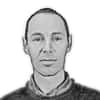
Now, having recently graduated from the School of Computer Science and Informatics Sciences, Arsalaan is reflecting on becoming a published lead author on a new research paper in Frontiers in Remote Sensing.
The first thing I did was print the paper out so I could keep it in my room alongside the poster I had made about our findings.
The 23-year-old was born and raised in Oman, where the geography of his homeland inspired the idea behind the research paper.
“I developed a real interest in landslides, living among the mountains,” Arsalaan remembers.
“In Oman, authorities take extensive measures during road and settlement construction to prevent natural disasters, which are increasing because of the effects of climate change.”
A “black box problem”

The paper, co-authored by Arsalaan’s mentors Dr Oktay Karakuş and Professor Paul Rosin, examines the use of satellite AI in mapping natural disasters such as landslides.
The team explore a “black box problem”, where current AI models are bloated by up to 30 layers of data making them slow, expensive, and impossible to audit.
Instead, they developed a framework that strips away redundant data to create a compact, 8-channel AI model that matches the accuracy of massive systems but runs significantly faster.
This allows life-saving disaster AI to run on cheaper hardware, the researchers claim.
Their solution also runs in resource-constrained environments, delivering fast, explainable maps to emergency teams when every second counts.
The opportunity to make his idea a reality came about when Arsalaan applied for an on-campus internship.
“I reached out to a few professors about the idea to work on something related to landslide segmentation, but most of them were pretty sceptical,” he said.
“Professor Paul Rosin, who was our module leader for Computational Maths thought the idea was interesting and he encouraged me to write an internship proposal.
“I took a lot of time over it, researching different angles we could approach and met with Paul to see what might work best. Eventually the proposal was accepted, and I got to take full ownership of the project from beginning to end!”
Professor Paul Rosin, Professor of Computer Vision at Cardiff University’s School of Computer Science and Informatics and one of the paper’s co-authors, said: “The ideal outcome of our on-campus internships is to create something which might be publishable but, in my experience, it is rarely achieved. Of course, some work was required to create and revise a technical description of Arsalaan’s work to a level suitable for publication. But he did it!
“Overall, I am very pleased with the outcome. There are many challenges to overcome such as learning a large amount of new information in a short time, learning new research and writing for publication skills, as well as coping with the demands of his regular course workload.”
Given that Arsalaan rose to this challenge then I expect he will continue to succeed in the future. I wish him the best of luck!
“An on-campus internship gave me the environment to start”
“The response has been overwhelming,” Arsalaan explains.
“I’ve had a lot of praise over the fact that I published a first-author paper as an undergraduate. I understand this isn’t common, but I’d encourage others to do the same. Don’t wait for a PhD or try to solve massive, saturated problems. Pick a narrow, specific bottleneck where you can apply skills you already have.
“Most importantly, be proactive about reaching out. Professors and research groups are actively looking for students who can build and execute. An on-campus internship gave me the environment to start, but the work happens when you treat research as practical problem-solving.
“It’s also really important not to be discouraged when your original idea doesn't work out. Research is all about trying things from different angles. Don't be afraid to ask for guidance, pivot here and there, and you'll eventually land on something worthy writing about.”
With an academic paper already under his belt and ambitions for another, postgraduate study and research might seem like the obvious destination for Arsalaan.
It’s just the start. I believe I can do a lot more; I'm just 23, after all.
“I have thought about a PhD, and I love publishing papers but right now, I’m thinking of taking my skills into the vast startup market in the UK.”
Arsalaan was recently accepted onto the Autumn 2026 cohort of Entrepreneurs First, an international business incubator and venture capital firm, which supports individuals in building technology companies.
Selected among the top 2% of candidates from an international and competitive applicant pool of more than 3,000 people, he plans to use the opportunity to pursue his own startup in energy and climate technology.
“I want to take direct ownership of translating remote sensing and computer vision research into deployed commercial products before considering a PhD down the line,” he explains.
“Building for the real world right now is where the biggest impact lies.”
Share this story

Find out more about research in the School of Computer Science and Informatics, our research areas and our global impact.


