Cardiff University REF 2029 Code of Practice
- Last updated:
Part 1: Introduction
1. How does your CoP support the principles of robustness, transparency and equity and inclusion?
Cardiff University’s REF 2029 Code of Practice (CoP) has been developed around the principles of robustness, transparency and equity and inclusion. These touchstones support the delivery of Cardiff University’s strategy, Our Future, Together, co-creating and sharing new knowledge to deliver a better world for future generations. In particular:
Robustness
- We will ensure accountable and representative leadership across teams involved in developing our submission.
- Robust systems, audit processes and - where relevant - independent quality assurance, will facilitate consistent practice and application of those processes across the organisation.
- Leadership teams will use data-informed decision-making to support the REF 2029 submission, informed by both qualitative insights and contextual understanding.
- Decisions will be taken in accordance with the framework set out in this Code of Practice.
Transparency
- The development and implementation of our CoP have been driven by stakeholder engagement with our academic and professional services communities. A draft was published on the intranet for staff to read and consider, and they were invited to respond using an online form, via email or verbally at information events. Information events were delivered online and open to all, alongside targeted information sessions for key stakeholder groups identified in our communications plan. Staff who were on leave of absence when engagement opened were contacted directly to signpost relevant information.
- The Code of Practice and all relevant documentation are bilingual.
- The final, approved REF 2029 Code of Practice will be published on our web pages and available externally, meeting digital accessibility formats. We will use our intranet pages to supplement the CoP with related resources and signpost to relevant internal policies and processes.
- Our policies and procedures promote transparency, requiring the communication of decisions regarding independence and research assessment outcomes relating to outputs and developing impact case studies.
Equity and Inclusion
Our submission will:
- Be representative of the research undertaken across our submitting units, reflecting the full range of research activity.
- Showcase the achievements of our diverse community, demonstrating the success of colleagues at all career stages and on varied career pathways.
- Be informed by, and delivered according to, our Integrated Impact Assessment, an evidence-based tool to promote equality in relation to policymaking and consider the impact of our policy decisions on the Welsh language.
These principles directly build on our REF 2021 Code of Practice and align with our wider vision for a positive research culture and associated institutional values. They support a ‘one-university’ approach to REF 2029 submission that prioritises excellence for the benefit of our research community.
2. Contextualisation within Institutional Policies
Equality, Diversity and Inclusion
Our Strategic Equality Plan 2024-2028 sets out our vision for a truly inclusive culture free from discrimination and based upon the values of dignity, courtesy and respect. We recognise the right of every person to be treated in accordance with these values and are committed to actively removing barriers to participation and progress.
The Strategic Equality Plan is based around three objectives and covers the protected characteristics of age, disability, gender reassignment, marriage and civil partnership, pregnancy and maternity, race, religion or belief, sex (gender), and sexual orientation. It also covers our commitment to advancing the Welsh language and to working in an intersectional way – recognising how different aspects of a person’s identity can combine to create unique experiences of advantage or disadvantage.
Cardiff University has taken a programme-led approach to delivering our Strategic Equality Plan. This means we are using programme management tools to ensure the plan is delivered with clarity, accountability and impact at all levels:
- A Strategic Equality Plan Programme Board, chaired by our Deputy Vice-Chancellor, meets regularly to oversee progress, manage risks, and steer key projects. It reports to the University Executive Board and provides onward assurance as appropriate
- Our Equality, Diversity, Inclusion and Anti-Racism Hub is based in the Vice-Chancellor’s Office and reports to the Deputy Vice-Chancellor. The Hub team was established to facilitate strategic change by embedding equality, diversity, inclusion and anti-racism at all levels of the university.
- Each of our colleges has an Associate Dean for Equity, Diversity, Inclusion & Anti-Racism, providing senior academic leadership on institutional EDI priorities, developing strategies to meet university success measures for EDI and supporting and assessing school EDI initiatives.
- Each school and professional services department has a member of staff who acts as a contact for EDI issues. These contacts attend meetings to receive updates on developments in equality policy and share best practice.
- Additionally, we bring together colleagues to share ideas and drive change through an inclusive EDI Community of Practice. These sessions create space for learning, reflection and action across our university community, covering areas such as developing an impact assessment mindset, reporting race hate crime to the police, and neurodivergent inclusion.
Cardiff University is committed to ensuring that fixed-term, part-time, and contract research staff are supported equitably in all aspects of their employment and research activity. In line with institutional policy, staff with more than four years of continuous service across projects normally transfer to an open-ended contract with a relevant factor, supporting continuity of employment. The experiences of fixed-term and part-time researchers inform equality impact assessments and institutional improvement activity.
Strategy, People and Research Environment and Responsible Research Assessment
As a signatory of the San Francisco Declaration on Research Assessment (DORA), we support and promote the responsible use of metrics and quantitative indicators of research. We are committed to assessing research in all its forms and applying the following principles of responsible research assessment:
- Recognising the diversity of contributions to, and careers in, research, in accordance with the needs and the nature of the research.
- Basing research assessment primarily on expert qualitative evaluation, for which peer review is central, supported by the responsible use of quantitative indicators.
- Prohibiting the use of inappropriate journal and publication-based metrics in research assessment, in particular the use of the journal impact factor and the h-index.
- Prohibiting the use of rankings of research organisations in research assessment.
As a university community, we are committed to freedom of enquiry through peer review in its broadest sense. Our commitments, both as a university and as individual researchers and decision-makers, are set out in Cardiff University’s Policy Statement on Responsible Research Assessment.
Artificial Intelligence
The University recognises Artificial Intelligence (AI) as a potentially useful tool to augment human capability, enhance research and innovation, and advance our mission whilst maintaining human agency as central to everything we do. We will be guided by the following core principles:
- Human-first approach: AI supports, not replaces, human judgment, creativity, authentic voice, and critical thinking across our community. We recognise the importance of maintaining human originality and oversight, and valuing diverse perspectives.
- Responsible AI use: We adopt AI transparently and accountably, guided by robust information governance, ethical principles, and attention to privacy and intellectual property. We are mindful of bias and its potential impact on fairness and inclusion.
The integration of AI and digital tools into institutional REF preparations will be subject to an oversight framework governed by our REF Strategy Group. Our position, which will be subject to regular review and informed by the guidance published in the Panel Criteria and Working Methods, concerns the following:
- The use of AI to blindly score outputs for REF without human consideration or to make final judgements about research quality is prohibited.
- Assistive tools to support critical thinking, as well as any specialist or complex use cases, such as functions which need to be reproduced multiple times or across multiple disciplines or tools for analysis, will be subject to review within our oversight framework before use.
- AI that can support administrative tasks with no direct link to REF decision-making and that can be undertaken by a trained user through existing tools is permitted and subject to the core principles identified above.
3. Update on Actions Since REF 2021
Cardiff University takes seriously its obligations to equalities duties seriously, both as a public organisation and in the context of key legislative frameworks. Previous equality impact assessments identified a number of priority areas for development and improvement, which have received investment since REF 2021:
i. The need to support staff to prepare them for the highest levels of performance for the next REF.
- In 2022 we established our Supporting Research Excellence Programme, a multi-faceted programme of initiatives to embed good practices and procedures in support of quality across the research portfolio.
- The programme provides a common framework under which colleges and schools can develop and implement processes appropriate to the size and nature of their disciplines.
- Our approach emphasises disciplinary ownership, empowering delivery across schools against the following expectations through distributed leadership and proportionate management:
- understanding REF 2021 performance, identifying priorities and risks
- creating culture and practices to promote the long-term development of quality outputs and impact
- building a vibrant research community to promote collaboration across diverse groups
- capturing relevant information about the pipeline of research and anticipated quality by engaging in regular peer review activity.
ii. Emphasis on robust, transparent, and fair output reviewing practices within schools.
- Whilst recognising that disciplinary differences may necessitate some variation in processes, we have established a common approach to output peer review across the university, embedding principles of accountability, inclusivity, excellence, and transparency.
- Peer review is delivered supportively, fostering an inclusive environment which encourages ambition and where everybody engages in conversations about quality.
- Whilst qualitative peer review is the primary method of research evaluation at Cardiff University, we have developed our Statement on Responsible Research Assessment to guide the responsible use of research metrics, such as article-level citations, recognising that they can be useful indicators of scholarly influence in some disciplines.
- We have invested in an output peer review module in Converis, our research information system, to facilitate output peer review as part of business-as-usual activities. It enables disciplines to organise and retain information about the pipeline of research and to monitor EDI implications on an ongoing basis.
iii. Positive change to the culture through proactive efforts.
- We have invested in building a positive, values-based research culture:
- appointment of University Dean for Research Environment and Culture, and dedicated professional services support through our Research Excellence and Culture Team (6FTE).
- commissioned our inaugural Research Culture Survey to collect views from the community; findings were published in September 2023.
- developed an evidence-led institution-level research culture action plan; informed by the Research Culture Survey it is tailored to our environment and based on the experiences and perspectives of our staff.
- our Research Culture Development Group is responsible for implementing the research culture action plan and reports to the University Research Committee.
(iv) Ongoing commitment to understanding the impact of EDI in research:
- Establishment of our EDI Hub to drive strategic change in this area.
- Development of our data systems and key datasets to enable monitoring of equality at a local and institutional level, including how staff with key protected characteristics are being supported to achieve in research and innovation.
- Ongoing liaison with both the Strategic Equality Plan and Athena Swan action plan to ensure actions are rationalised and clear across these strategic drivers.
- Continuing to promote and require completion of EDI and unconscious bias online training by all university staff.
- Our Equality, Diversity and Inclusion toolkit for researchers has been developed by academic and research professional support staff to help colleagues think about EDI in the context of their own research.
Additionally, as a response to feedback received from staff post REF 2021, the university established an Impact Projects Team (5 FTE). This team supports all impact projects from an early stage and the development of impact narratives, supporting our researchers with the management of impact funding, coordination and strategy partnering around impact plans, evidence gathering and reviews.
4. Governance and Compliance
Key Roles and Responsibilities
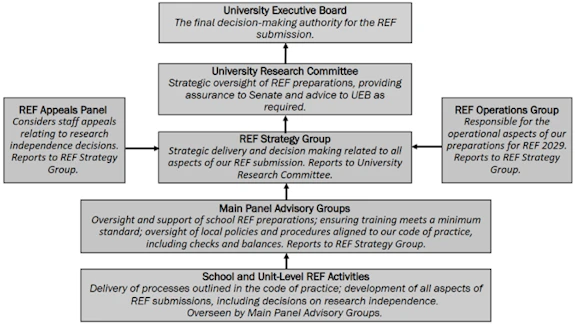
The primary decision-making and advisory roles relevant to our REF preparations can be summarised as follows:
- Institutional Leadership Roles: Vice-Chancellor; Deputy Vice-Chancellor; Pro Vice-Chancellor for Research, Innovation and Enterprise (and Pro Vice-Chancellors across other portfolios as relevant); Dean for Research Environment and Culture (and Deans for other strategic portfolios as relevant);
- Professional Services Leadership: Chief Operating Officer; Chief Financial Officer; Director of People and Culture; Professional Services Directors.
- College Academic Leadership: College Pro Vice-Chancellor; College Dean for Research and Innovation; Unit of Assessment Lead (see Appendix B), Associate Dean for EDI and Anti-Racism; Associate Dean for PGR.
- School Academic Leadership: Head of School, Deputy Head (People and Culture), Deputy Head (Research, Innovation and Enterprise); Head of Department or Division (where relevant); EDI Lead; Impact, Innovation and Enterprise Lead; PGR Lead.
Governance Structures
Cardiff University has robust appointment processes for membership of all committees and groups with decision-making and/or advisory roles:
- University Executive Board (Chair – Vice-Chancellor): The final decision-making authority for all aspects of the REF submission.
- University Research Committee (Chair - Pro Vice-Chancellor Research, Innovation and Enterprise): Strategic oversight of REF preparations, providing assurance to Senate and advice to UEB as required.
- REF Strategy Group (Chair – Pro Vice-Chancellor Research, Innovation and Enterprise): Responsible for strategic delivery and decision-making related to our REF submission. The terms of reference for the REF Strategy Group are provided in Appendix C.
- Main Panel Advisory Groups (Chairs – College Deans for Research and Innovation): Responsible for overseeing and supporting school REF preparations, ensuring training meets a minimum standard, quality assurance and oversight of policies and procedures aligned to the CoP. The terms of reference for the main panel advisory groups are provided in Appendix D.
- REF Appeals Panel (Chair – Deputy Vice-Chancellor): Responsible for considering appeals from staff related to research independence decisions.
EDI considerations are embedded in all the above decision-making groups, and these groups work within wider EDI structures in the university to ensure an integrated and joined-up approach.
Our CoP will be subject to scrutiny and approval through the relevant governance structures (REF Strategy Group, University Research Committee, UEB, Senate).
Equality Impact Assessment (Appendix A)
The University has introduced a new Integrated Impact Assessment (IIA) tool to facilitate compliance with the regulations and legislation. It includes consideration of the Welsh language and replaces the previous Equality Impact Assessment (EIA). We have used the IIA format to undertake an EIA of the policies and processes in this Code of Practice.
Our IIA examines whether the design and operation of the university’s REF processes align with the requirements of the Public Sector Equality Duty. It will provide documented evidence that this consideration was ‘conscientious, rigorous, and informed’ by relevant data and context.
We will prioritise the processes and impacts related to four key areas of our REF preparations in our IIA:
- decision-making on ‘significant responsibility for research’ and ‘research independence’
- the constitution of Units of Assessment (UoAs) through eligible staff activity
- output selection
- managing the appeals processes
While the IIA and its related analysis of staff equalities data will address the above areas, the entirety of the CoP will be considered within it. This will ensure coverage of other relevant aspects involving policy decisions, procedural frameworks, or institutional discretion as suggested in the guidance from the HE funders.
We will revisit our IIA annually and if policies or procedures change.
Training Requirements
We provide staff with three tiers of training, depending on their role in institutional REF preparations:
i. The wider academic community, as well as professional services in support roles
- Mandatory, regular Cardiff University research integrity, EDI and unconscious bias training for all staff.
- All colleagues are expected to engage with communications regarding REF-related activity, both at an institution and unit level, ensuring they are kept informed of relevant policies.
ii. Those in a reviewing or advisory role
- Tailored online training on responsible research assessment, EDI and unconscious bias.
- This training is designed to enable reviewers to be aware of and alert to the general biases that can be present when undertaking research assessment, so that they can approach the task in hand reflectively.
iii. Colleagues with decision-making responsibilities
- An in-person practical session to help people surface their own unconscious biases, giving them practical tools to improve decision-making.
- Participants will understand and know how to uphold measures that are in place to take account of EDI and ensure that the assessment is fair, consistent, and transparent
Part 2: Identifying Staff Contracts with Significant Responsibility for Research
As part of their contracts, all teaching and research staff at Cardiff University are expected to undertake research and have time included within their workload allocation to support appropriate research activity. This arrangement represents a continuation of the approach taken for REF 2021.
Significant responsibility for research does not apply to individuals on contracts where there is no expectation of research in the role (including teaching and scholarship contracts).
Part 3: Determining Research Independence
1. Policies and Procedures: Criteria and Evidence; Decision-Making and Communication
i. Staff on 'Research-Only' Contracts
These colleagues are line-managed through schools, and the relevant academic pathway is identifiable through HR systems. Research-only staff contracts will be identified using the approach outlined below, which is based on the independence criteria provided by the funding bodies.
ii. Criteria and Evidence
- The Research Excellence and Culture Team will provide an initial assessment of the research independence of research-only staff contracts based on the expectations outlined in generic job descriptions commensurate with the grade.
- The job description for a research-only contract of grade 6 and below expects that the role holder typically carries out specified research for a defined programme of work led by a principal investigator and would therefore not qualify as meeting the criteria for research independence.
- The job description for a research-only contract of grade 7 and above expects that the role holder typically undertakes self-directed research and would therefore qualify as meeting the criteria for research independence.
- For quality assurance purposes, schools, as the point of line management, will be required to verify that, for staff contracts at grades 6 and 7, the assessment made above is appropriate. This will involve verifying that none of the following criteria applies to the role or role holder of a grade 6 contract, or that one or more of the criteria apply to the role or role holder of a grade 7 contract:
- Being a successful lead applicant on externally funded research projects based on independent contribution.
- Holding an independently won, competitively awarded fellowship requiring research independence. The list of eligible research fellowships provided by the funding bodies will be used as a guide, but is not exhaustive.
- Leading a research group or a substantial/specialised work package.
- Research independence is an inherent expectation of the associated research contract.
- For UoAs 13-34, this may also include:
- being named as a co-applicant on an externally funded research grant/award;
- having significant input into the design, conduct and interpretation of the research.
- All processes identifying the independence or otherwise of research-only staff will be undertaken without reference to the consideration of staff outputs.
iii. Quality Assurance
- Main Panel Advisory Groups will provide oversight of the determination of research independence for research-only staff by schools.
- If research independence decisions deviate from the generic expectations of the job description outlined above, the associated Main Panel Advisory Group will assess the case and make a judgment based on evidence from the school, with support from HR.
- Membership of the Main Panel Advisory Groups will be predominantly independent from the school leadership teams involved in verifying the research independence of staff.
- Once identified in a staff contract, research independence will be considered persistent unless the requirements of a role have changed significantly since the initial assessment of research independence was undertaken, recognising that roles may evolve.
- Decisions regarding research independence will be taken as we carry out processes to complete our annual HESA staff data return each summer. The process will be repeated annually as part of business-as-usual activities.
iv. Communication and Timelines
- Line managers are encouraged to discuss the criteria for research independence with colleagues on research-only contracts during the annual Performance Development Review process, with a view to supporting staff to work towards research independence where this aligns with their career and research ambitions. Performance Development Reviews typically take place from 1 February to 31 May and are compulsory for all staff.
- We will record research independence decisions against staff contracts in our HR system for the purpose of making our HESA return and supporting wider REF-related reporting. Decisions will be visible to staff through their Core HR record.
- Where the Main Panel Advisory Group approves an independence decision which deviates from the assumptions typically expected from job descriptions, this will be clearly communicated to the affected member of staff and the appeals process will be signposted.
- The Research Excellence and Culture Team will coordinate the communication of research independence decisions (where relevant) each autumn, prior to the finalisation of our HESA staff data return.
2. Staff, Committees and Training
Policies and processes related to determining research independence will be subject to the checks and balances of the governance structures and training requirements outlined in Part 1, Section 4.
3. Appeals
The appeals process will be overseen by the Deputy Vice-Chancellor, who is the University Executive Board lead for EDI at Cardiff University. The appeals process will be co-ordinated by the Research Excellence and Culture Team, who will brief members of the appeals panel on processes by which research independence decisions have been taken.
Staff can appeal decisions about their research independence because due process has not been followed, or on the basis of a defect in the application of the Code of Practice. When communicating with staff about the outcome of independence decisions (see part 3.1.iv), we will also ensure that staff are provided with information regarding how to appeal that decision.
We will operate a two-stage appeals process (described in Appendix E):
- Informal Resolution: staff should raise any initial concerns with the Research Excellence and Culture Team who will review the evidence against our published criteria, taking account of any supplementary information and involving the relevant school leadership team as appropriate. Nominated representatives of the relevant Main Panel Advisory Groups, including a representative from HR, will review the decision.
- Formal Appeal: If the individual remains dissatisfied with the outcome, they have the right to submit a formal appeal, which will trigger an independent review by the Appeals Panel.
The mechanism for staff to request a review of decisions made in relation to research independence will be published on our intranet pages, as well as being communicated by email, through Blas (weekly newsletter for all staff), and through stakeholder engagement with formal and informal networks.
4. Equality Impact Assessment (EIA) Integration
We will surface and analyse staff data to understand whether individuals from certain groups are more or less likely to be classed as research independent and whether our processes in this area could be disadvantaging certain groups. In addition, we will analyse the proportion and associated characteristics of staff on research-only contracts whose determination of research independence does not align with the default expectations of the job description based on grade to determine whether this remains a useful presumption.
Part 4: Allocating Contracts to UoAs
1. Policies and Procedures: Criteria and Evidence; Decision-Making and Communication
Institutional Unit of Assessment Submission Approach
The university’s submission approach will be authentic, reflecting the strength of disciplinary research activity, and strategic, including minimising bureaucracy with cognisance of interdisciplinary interfaces. It will build on progress from our REF 2021 submission and capitalise on discipline-led expertise – including the context of sub-panel working practices – and critical mass for research environment and culture. It will seek to support long-term collective success.
It is important to note that REF 2029 policy breaks the link between – or ‘decouple’ – individuals and outputs in REF assessment. The allocation of a contract to a unit of assessment (UoA) does not necessarily imply the return of the associated individual’s outputs to this UoA. In this context, the allocation of contracts to UoAs is to determine the overall volume of activity that can be associated with units. Therefore, the criteria and evidence used to allocate contracts to UoAs will concern:
- Contractual basis for employment and scope of activity.
- Research activity undertaken, including cross-disciplinary relationships to unit descriptors.
- Alignment with the environment and available impact to ensure viability, strength and critical mass.
These elements will constitute both quantitative and qualitative data. As such, the process of allocation will involve iterative engagement to be undertaken with schools and UoA leads, coordinated by the Research Excellence and Culture Team.
The school is the point of responsibility for each contract and the context for employment, noting that schools may submit activity to multiple UoAs. The UoA lead (see Appendix B) will ensure alignment with the fitness and strength of the discipline, including cross-checking with aspects such as patterns of research income, doctoral qualifications, and prospective impact.
The process of allocating staff contracts to UoAs will run in parallel with the process to determine research independence and will be aligned to data collection for our annual HESA staff data return.
Overseen by the REF Strategy Group, our approach may be subject to further review at any point in the current REF cycle, particularly where there are organisational changes and/or changes to the composition of our emerging returns.
We will record UoAs against staff contracts in our HR system and review these annually. Subject to the interoperability of internal systems, this data will drive the reporting of REF-related data sets at a unit level and enable unit-level analysis through our IIA. The UoAs allocated to staff contracts will be visible to staff through their Core HR records. It is noted that, due to REF rules decoupling individuals from outputs, this neither infers the return of an individual’s outputs nor the UoA to which an output may be returned.
2. Staff, Committees and Training
Policies and processes related to allocating contracts to UoAs will be subject to the checks and balances of the governance structures and training requirements outlined in Part 1, Section 4.
3. Equality Impact Assessment (EIA) Integration
We will analyse data from our 2024/25 HESA staff return relating to academic schools that typically return to more than one UoA to understand whether contracts held by staff from certain groups are more or less likely to be returned to particular UoAs. During the period or engagement with staff on our draft Code of Practice, we will also use prompt questions in our feedback questionnaire and meeting discussions to explore whether staff feel that the proposed policy and processes for assigning contracts to UoAs have the potential to disadvantage them. We will ask specifically whether any disadvantage relates to a protected characteristic(s) or other personal circumstances.
If this engagement and analysis suggest the potential for negative impacts on certain groups or to improve equality of opportunity, we will reflect on any element of policy or process that is contributing to such effects and intervene where appropriate.
Part 5: Selecting outputs
1. Policies and Procedures:
Identifying substantive links to outputs
No output selection decisions will be taken before the university’s Code of Practice receives approval from Medr. We will work with school leadership teams and research offices to undertake initial eligibility checks, identifying a substantive link to all submitted outputs through an eligible employment relationship with an author. A linked author must have a contract which:
- Can demonstrate a minimum of 0.2FTE for at least 12 months of continuous employment; and
- Includes a role descriptor with an explicit expectation of research activity.
We will use existing corporate systems to cross-reference employment dates, staff FTE and career pathway with the publication date of the output. We will use the output peer review module in our research information system to record and verify the rationale and evidence for a substantive link via an eligible employment relationship.
For those on an academic contract, the career pathway will enable us to accurately identify all colleagues with an expectation of research in their role. For those in wider research-enabling roles on managerial and professional services pathways (including technicians), we will refer to job titles and supplement with local knowledge as appropriate to ensure all potential outputs linked to staff in this category are considered equally.
In line with the published guidance, an eligible employment relationship must be evidencable either:
- At the point the output was first made publicly available; or
- During a time-limited period before the output was first made publicly available, when the research resulting in the output was carried out (two years for the majority of outputs; five years for long form and/or extended process outputs); or
- By exception, up to 5 years after the output was first made publicly available for long-form and/or extended process outputs.
Long form and/or extended process outputs must meet the definitions provided in the Guidance on Submission and Panel Criteria Working Methods. Any outputs submitted on the basis of research resulting in the output being carried out prior to the eligible employment relationship will be subject to scrutiny by the relevant Main Panel Advisory Groups.
Under exceptional cases, where resources have supported a specific research activity, a UoA may consider outputs solely authored by staff on teaching-only, honorary emeritus or other non-research contracts for submission. In such instances, a justification will be considered by the REF strategy group. Only with endorsement from the REF strategy group will a formal request be made to the REF director within the UK REF Team for such an output to be included in our submission.
Selecting outputs where the substantive link is via former staff
Where the substantive link to an output exists via a former staff member, the output will be eligible for selection where the author:
- has elected and taken voluntary redundancy or severance
- has left after the expiry of a fixed-term contract
- has retired
Aligned to REF 2029 policy, outputs where the substantive link to the University occurred before the submitted output was made publicly available will not be eligible for submission where the author was subject to compulsory redundancy from Cardiff University. Where such an output is multi-authored, and a substantive link can be evidenced by another eligible employment relationship, outputs will be considered for inclusion on a case-by-case basis against the context of the substantive link.
Assigning outputs to UoA/s
The UoA to which the author demonstrates a substantive link to an output is assigned will drive an initial allocation of outputs to UoAs, but will not be the sole determiner for the UoA to which an output is submitted. We will explore porosity in UoA boundaries where outputs genuinely make contributions that are multifaceted. For such outputs, a justification will be developed and examined as to how outputs authored by an individual on a contract allocated to a different UoA meet the research descriptor for the unit(s) to which it is being allocated. This justification must align with published REF guidance and will be subject to scrutiny by the relevant Main Panel Advisory Group(s).
Procedures for supporting diversity of outputs
We value research in all its forms and arising from a diverse range of research practices. All output types are recognised by the systems and processes facilitating output peer review. The strength of interdisciplinary research will be recognised in any/all of the UoAs in which it meets the research descriptor.
Diversity extends to linguistic inclusion, and we are committed to ensuring outputs in British Sign Language (BSL) and Welsh will not be treated less favourably than those in English. Outputs submitted in Welsh or BSL will be assessed directly in their original form, without requiring translation or interpretation. Where we do not have the expertise to assess an output appropriately, we will seek specialist advice externally. Research produced in BSL or Welsh will be treated equally, from the point of discoverability through to selection decisions. Working with our Dean for the Welsh Language, we will integrate content into our training to guard against language-related exclusion or bias in output selection. We will also promote the importance of research conducted in Welsh, recognising that conducting research in Welsh across different fields is an integral part of Wales' research ecosystem.
Procedures for ensuring submissions are representative of the research undertaken within the submitting unit during the REF period
School leadership teams and UoA leads will have responsibility for ensuring the representativeness of our return at a unit level. Oversight of the decision-making process will be provided by the Main Panel Advisory Groups, who will require assurance that due consideration has been given to relevant factors, including (but not limited to):
- Representing the scope of the research activity in the submitting unit
- Ensuring excellence in the selected submission
- Alignment with the submitting unit’s research strategy
- Appropriate diversity of output types
- Promoting open access publishing models and open research practices
- The distribution of substantive links to outputs, including by career stage and role type, where relevant
- Instances where the recommended maximum of 5 is exceeded
- The proportion of outputs included where the substantive link is via a former staff member.
Policies and procedures, and responsible research assessment practice
The output peer review process
We take a common approach to output peer review across the university, embedding principles of accountability, inclusivity, excellence, and transparency. All schools are expected to embed the use of internal peer review as part of business-as-usual activities. Whilst recognising that school structures and disciplinary differences necessitate some variation in processes, we have established minimum expectations and general process guidance for peer review activities to ensure consistency:
i. All outputs selected for peer review should be read by individuals who have received the appropriate training as identified by their school.
ii. The assessment of output quality should recognise the contribution of all output types and align with REF criteria.
iii. Each output should have a minimum of two reviews. Where there is a scoring discrepancy between peer reviews, a moderated score should be determined by engaging a third reader, arbitration by a senior academic, or the application of transparent scoring assumptions.
iv. Outcomes of output peer review should be recorded using the output peer review module in Converis, our research information management system, noting the following:
- All outputs should be given an overall moderated score using the 13-point scale (1* to 4*, high/medium/low, plus unclassified).
- Author attribution of multi-author outputs should be captured using a clearly defined and equitable approach appropriate to disciplinary practices and norms. Our research culture action plan promotes the use of CRediT (Contributor Roles Taxonomy) where appropriate.
v. Authors should be given feedback on the overall scores of outputs attributed to them in the peer review module. Where this is not already routinely the case, schools should actively work towards establishing open and transparent processes.
vi. As part of our commitment to continuous improvement, we identify and share good practice across the university. Schools are encouraged to reflect on potential enhancements to their processes, including but not limited to:
- Self-nomination of outputs and pre-publication peer review.
- Provision of narrative feedback to supplement the score provided, which can contribute to conversations around long-term publishing planning as a routine activity for all staff.
- Separate scores and/or comments recorded for originality, significance and rigour.
- Reducing the risk of bias by using double blind peer review, exploring opportunities for anonymisation where feasible.
- The use of appropriate external assessment in the calibration of our understanding and application of quality criteria to outputs.
Peer review should be delivered supportively, fostering an inclusive environment which encourages ambition, where everybody engages in conversations about quality. Whilst qualitative peer review is the primary method of research evaluation at Cardiff University, research metrics, such as article-level citations, can be useful indicators of scholarly influence in some disciplines as set out in Cardiff University’s Statement on Research Assessment. These metrics should only be used when relevant to the discipline, as reflected in the panel criteria and working methods.
Output peer reviewers
Schools should identify appropriate and representative reviewing teams. Less experienced reviewers should be provided with appropriate support and training from experienced reviewers. The reviewing team should be representative of the school, including consideration of gender and ethnicity as well as disciplinary breadth. The number of colleagues on a reviewing team may vary depending on the size and disciplinary makeup of the school.
Expertise in reviewing teams should incorporate the full range of research areas covered by the school. Where a colleague with the relevant disciplinary knowledge and training is not available to provide a review, cross-referral should be considered to other reviewing panels across the university – the Research Excellence and Culture Team will facilitate this process. If expertise is not available in the university, an external review should be sought.
All members of the output review teams should receive relevant training to support their work, including but not limited to:
- Mandatory online training modules in EDI and Understanding Unconscious Bias.
- Understanding of REF quality and what this looks like for the disciplines they cover.
- Undertaking discipline-specific calibration exercises to hone the consistency of reviewers’ scoring, and working collaboratively to provide peer-to-peer support to each other.
- Engaging in regular EDI discussions related to REF at a school level.
- Centrally co-ordinated EDI/fairness in assessment training.
Schools should coordinate calibration exercises within the reviewing team to ensure reviewing decisions are consistent and robust.
2. Staff, Committees and Training
Policies and processes related to selecting outputs will be subject to the checks and balances of the governance structures and training requirements outlined in Part 1, Section 4.
3. Equality Impact Assessment (EIA) Integration
We are cognisant that data for REF 2021 indicated staff from certain groups were less likely to be predicted 4* outputs than others. In addition to implementing the training on responsible research assessment, EDI and unconscious bias described in Section 1, Part 4 above, we have developed standardised expectations for output peer review to embed good practices that encourage equity across the university.
Further, our plans to consult relevant data as our IIA develops include analysis to explore whether our processes are unintentionally favouring some groups. We will compare demographics/incidence of protected characteristics for authors of outputs achieving different scores through our peer review systems. Fine-grained analysis involving the 13-point scale employed internally will be undertaken to give as full a picture as possible. We will also look at data on the scoring of outputs in Welsh to understand any differences in scoring decisions according to language.
Appendix A: Integrated Impact Assessment
Proposal name & brief description: Cardiff University REF 2029 Code of Practice: Integrated Impact Assessment
Background and context
The Research Excellence Framework (REF) is the UK’s system for assessing the quality of research in higher education institutions. This regular exercise is a process of expert review, carried out by sub-panels focused on subject-based units of assessment (UoAs), under the guidance of overarching main panels and advisory panels. In 2029, UoAs will be assessed on three elements of their research activity: contribution to knowledge and understanding; engagement and impact; and strategy, people and research environment.
The REF 2029 results will be used by Medr to inform the allocation of quality-related (QR) funding to institutions in Wales. The outcomes will also have implications for Cardiff University’s reputation and its rankings within sector league tables. To take part in REF 2029, the university must develop and publish a Code of Practice (CoP) that explains how we will make key decisions about our submissions. The CoP must be based on the principles of robustness, transparency, equality, diversity and inclusion (EDI) and informed by an Equality Impact Assessment (EIA).
The UK higher education funders have published guidance on conducting EIAs.
We are using Cardiff University’s standard format for EIAs (called Integrated Impact Assessments/IIAs internally to acknowledge the incorporation of Welsh Language requirements) to present our assessment.
Scope of this IIA
We are required to assess the whole of our REF 2029 CoP within this document and to give particular consideration to four core REF-related processes:
- decision-making on ‘significant responsibility for research’ and ‘research independence’;
- allocating eligible contracts to UoAs;
- selecting outputs;
- and managing appeals processes.
Our assessment and the related analysis of staff equalities data will focus mainly on the above areas, but will also cover other relevant aspects involving policy decisions, procedural frameworks or institutional discretion.
With regards to point a) above, because Cardiff University records all ‘teaching and research’ (T&R) contracts as having significant responsibility for research in its HESA staff record, we will not consider procedures for identifying significant responsibility for research in this assessment. However, we will be alert to any trends in our equality data in relation to staff holding contracts with significant responsibility for research that could indicate inequities in access to contract types and career pathways.
As a Welsh institution, it is particularly important that we ensure that outputs written in Welsh are handled fairly and that research that is focused geographically on Wales or concerned with Welsh themes such as the country’s society, culture, politics or language is not disadvantaged. Moreover, our REF-related processes must not put colleagues who speak Welsh at a disadvantage. In addition to the UK higher education funders’ standard guidance on conducting an EIA for REF 2029, Medr will be publishing information on the Welsh language and REF. We will review and update this assessment once this publication is available.
This IIA is a living document that is developing alongside our CoP and the policies and processes that support our REF submission. As such, it will be reviewed and updated regularly. We will revisit the assessment annually and when policies or procedures change.
Approach to equality, diversity and inclusion in Cardiff University’s policies and processes for REF 2029
We are taking various steps to ensure that EDI receives due consideration in our REF 2029 policy and process development and to make sure our practices and procedures do not discriminate against, disadvantage or exclude staff with protected characteristics and that they promote equality of opportunity.
As outlined in Part 1, Section 4 of the Code of Practice (CoP) that this IIA accompanies, we have taken the decision to embed consideration of and expertise relating to EDI into all the groups with responsibility for leading and scrutinising our REF-related policies and processes, rather than establishing a separate panel for this purpose. We are committed to fully integrating EDI into all conversations and decisions. Colleagues with specific knowledge of EDI (for example, Associate Deans for EDI) will advise on EDI matters in each of our groups, ensuring appropriate degrees of seniority and specialist knowledge.
As also detailed in the CoP, we have devised a three-tier training offering to support the embedding of EDI into our REF procedures and to encourage all staff to view themselves as responsible for ensuring the equity and inclusivity of our processes:
- The wider academic community, as well as professional services in support roles, are required to complete mandatory, regular Cardiff University EDI and unconscious bias training for all staff.
- Those in a reviewing or advisory role must undertake tailored online training on responsible research assessment, EDI and unconscious bias. This training is designed to enable reviewers to be aware of and alert to the general biases that can be present when undertaking research assessment, in order that they can approach the task in hand reflectively.
- Colleagues with decision-making responsibilities will attend an in-person practical session to help them surface their own unconscious biases, giving them practical tools to improve decision-making. They will understand and know how to uphold measures that are in place to take account of EDI and ensure that assessment is fair, consistent and transparent.
As detailed in our CoP, Cardiff University is a signatory to the San Francisco Declaration on Research Assessment (DORA). We recognise the inequities that can arise from an overreliance on metrics to evaluate research outputs. The development of quality profiles to inform the selection of outputs for our REF 2029 returns will be based primarily on expert peer review.
Processes for declaring extenuating personal circumstances and consideration of EDI are incorporated into the internal application and assessment processes for opportunities that affect research opportunities and access to research time, for example, the university research leave scheme.
Depending on the findings of the engagement and analysis of evidence that we plan to undertake (see next substantive section for details), we will explore options for targeted support for certain groups to increase equality of opportunity.
Responsible director: Roger Whitaker, Pro Vice-Chancellor for Research, Innovation and Enterprise
The officer completing the IIA: Jenny Hulin, Head of Research Excellence and Culture; Elinor Shepley, Research Excellence and Culture Officer
What evidence or consultation has been used to determine the impact on different groups?
Evidence
A note about our data
The data used to inform this assessment draws on HR records. It is based on declarations at the point of contract issue, supplemented by annual reminders to staff to check and update where necessary. The data was sourced in March 2026 and may have been subject to minor updates since then to reflect ongoing quality assurance.
This data has known limitations, with data for certain characteristics not clearly categorised into discrete groups. Specifically, for staff in the 2024/25 academic year:
- For disability data, 190 staff (8.3%) in our T&R and research-only cohort are in the ‘prefer not to say’ category, and 166 (7.2%) are in the ‘unknown’ category, compared to 171 (7.4% of total) in the ‘yes’ category, and 1,769 (77% of total) in the ‘no’ category;
- For ethnicity data, 131 staff (5.7% of the T&R and research-only cohort) are in the ‘unknown’ category, and 68 (3%) are categorised as ‘withheld’. This compares to 473 (20.6%) people from ethnic minority backgrounds and 1,624 (70.7%) who class themselves as white.
Whilst the above limitations are large enough to shift some of the adverse impact findings in this IIA, if all in such a category were to move into one of the other clear categories (e.g. all unknown ethnicity categories being white), there is no evidence to suggest the group opting not to provide data is unrepresentative of the wider population and would skew one way or the other. This limitation should not, therefore, undermine findings of adverse impact where specific categories are clearly identified.
Changes since REF 2021
- For REF 2021, our eligible population was 1,481. In 2024/25, 1,606 staff held volume-contributing contracts.
- Female staff made up 36% of the eligible cohort for REF 2021. In the 2024/25 academic year, 39.5% of staff holding contracts that contribute to the volume measure were female. (Our designations use declared biological sex, rather than gender identity.)
- Staff from ethnic minority backgrounds made up 13% of the eligible cohort in 2021. In 2024/25, 18.7% of staff with volume-contributing contracts were from ethnic minority backgrounds (74.2% were white, and the ethnic background of the remaining 7.1% was either withheld or unknown).
- Staff with declared disabilities made up 4.4% of the eligible cohort for REF 2021. In 2024/25, 7.8% of staff with volume-contributing contracts had declared a disability (77.8% had no disability declared, and the remaining 14.4% preferred not to say or the information was unknown).
These comparisons suggest that the pool of staff linked to the university’s volume measure has become more diverse since REF 2021, continuing a trend observed between REFs 2014 and 2021 (as discussed in our Equality Impact Assessment for REF 2021). It should be noted, however, that this group remains somewhat less diverse than the complete cohort of T&R and research-only staff. 44.6% of staff within this broader community are female and 20.6% are from ethnic minority backgrounds. The percentage of staff with volume-contributing contracts who have declared a disability (7.8%) is in line with the figure for the community as a whole (7.4%).
Data specification
We have identified key questions about the impact on different groups of the four core REF-related processes covered by our CoP. The table below sets out these questions, the initial approach to answering them using staff data and the point at which we expect to have this data available.
| Core process | Questions to answer | Suggested approach | First round of analysis expected |
|---|---|---|---|
| 1. Decision-making on ‘significant responsibility for research’ and ‘research independence’ | a. Are staff from different groups more/less likely to have significant responsibility for research? b. Are staff from different groups more/less likely to be classed as research independent? c. Are our processes disadvantaging certain groups? d. Are staff from different groups more/less likely to be on particular career pathways? | Compare demographics/ incidence of protected characteristics for:
Ensure that analysis includes comparison of incidences of part-time working amongst different contract types and in research independent versus non-independent staff pools. Also, ensure consideration of intersections between early career (age) categories and ethnic minority background characteristics. | Initial data considered in March 2026 (see below) |
| 2. Allocating eligible contracts to UoAs | Are staff from different groups more/less likely to be allocated to particular UoAs? | Focus on selected schools that submit to more than one UoA (e.g. MEDIC and SOCSI) and compare the demographics/ incidence of protected characteristics of staff assigned to different UoAs. | Initial data considered in March 2026 (see below) |
| 3. Selecting outputs | a. Do our decision-making practices unintentionally favour outputs from certain staff groups? b. Are outputs authored by staff from certain groups more/less likely to be allocated particular scores? Where UoAs/ academic schools ask staff to nominate outputs expected to be predicted a particular grade for peer review, are staff from certain groups more/less likely to view their work as being of adequate quality? Are staff from certain groups being disadvantaged? | Compare demographics/ incidence of protected characteristics for authors of outputs achieving different scores through our peer review systems. Note: outputs are scored on a 13-point scale. Some fine-grained analysis (e.g. of the likelihood of scoring a 3 High versus a 4 Low) is likely to be needed. Compare the number of outputs self-nominated by staff from different groups and the resulting scoring patterns. Compare the average scoring of outputs authored by people who have been on maternity/adoption leave with the scoring for outputs authored by those who have not been on leave. | June 2026 December 2026 |
| 4. Appeals processes | a. Are staff from certain groups more/less likely to appeal a decision about their research independence? b. Are appeals by staff from certain groups more/less likely to be successful? | Compare demographics/ incidence of protected characteristics for:
| December 2026 (initial dataset) |
First consideration of data: March 2026
T&R staff and significant responsibility for research
As outlined above, because Cardiff University records all T&R contracts as having significant responsibility for research in its HESA staff record, we do not consider there to be a risk that our policies and processes relating to this decision will disadvantage particular groups of T&R staff. However, we are aware that female staff and those from ethnic minority backgrounds are somewhat under-represented in the T&R career pathway when compared to the wider pools of staff with volume-contributing contracts and the complete community of T&R and research-only staff. 37.2% of T&R staff were female in 2024/25, which is low in comparison to 56.2% of research-only staff and 44.6% of the full community. 18% of T&R staff were from ethnic minority backgrounds, compared to 24.5% of research-only colleagues, creating an average of 20.6% of the combined T&R and research-only pool.
Research-only staff and research independence
In our 2024/25 staff data, 207 members of research-only staff (23%) were linked to contracts classified as including research independence and 693 (77%) were linked to contracts not classed as independent. The gender balance was comparable in both groups: 55.1% female for the research independent group and 56.6% female for the non-independent.
The proportion of research independent staff with ethnic minority backgrounds was slightly lower than in the non-independent group, at 22.7% and 25.1% respectively. Although this difference is not great enough to assume statistical significance, as the population is small (overall population sizes are 207 research independent and 693 non-independent), we will consider our 2025/26 and 2026/27 data closely to ascertain whether a trend might exist. In this context, it is worth noting that the data for all research-only staff suggest people from ethnic minority backgrounds are less visible at higher research-only grades than at grades 4 to 6. In 2024/25, 24.9% of research-only staff at grades 4 to 6 were from ethnic minority backgrounds compared to 16% at grades 7 to 9 and senior staff level.
The incidence of staff declaring disabilities did not differ significantly between the research independent and non-research independent groups, at 6.3% and 6.6% respectively.
The non-research-independent cohort was younger on average than the research-independent group. 81.2% of those on non-independent contracts were aged between 25 and 44, with 51.5% in the 25-34 age bracket. In comparison, 13.5% of the research independent group were aged 25-34, 44% were 35-44, and 30% were aged 45-54. Table 1 below provides more detail.
Table 1: Research-only staff, age and research independence of contracts
| Research independence | Age | Distinct headcount | Percentages |
|---|---|---|---|
| 01- Contract is classed as research independent | Total | 207 | |
| 16-24 | 0 | ||
| 25-34 | 28 | 13.5% | |
| 35-44 | 91 | 44.0% | |
| 45-54 | 62 | 30.0% | |
| 55-64 | 20 | 9.7% | |
| 65+ | 6 | 2.9% | |
| 02- Contract is not classed as research independent | Total | 693 | |
| 16-24 | 13 | 1.9% | |
| 25-34 | 357 | 51.5% | |
| 35-44 | 206 | 29.7% | |
| 45-54 | 92 | 13.3% | |
| 55-64 | 24 | 3.5% | |
| 65+ | 1 | 0.1% |
The difference in age distribution between the two cohorts might be expected given the links between grade and independence classification, and also between age, experience and career progression. However, we should not overlook the fact that there were more non-independent staff in every age category except 65+. The fact that only 23% of research-only staff hold contracts that are classed as research independent links to wider, ongoing conversations about the level of opportunity and support for these staff to progress in terms of grade and independence, if that is their aspiration.
Consideration of ethnicity and age distribution in our research-only cohort suggests that there is greater diversity amongst the younger, early- to-mid career element. Numbers are too small to consider the data in ten-year age bands (the complete population is 898), but, in 2024/25, 26.5% of research-only staff in the 16-44 age range were from ethnic minority backgrounds compared to 17.6% of those who were 45 or older.
Data relating to working patterns suggest that part-time working does not prevent research-only staff from securing contracts classed as research independent. Staff whose contracts include research independence were more likely than those without research independence to work part-time. 31.4% of those with independent contracts worked part-time, in comparison to 16% of those whose contracts were not classed as independent.
The observations outlined above do not suggest that the university’s processes for making decisions about the independence or otherwise of research-only contracts are disadvantaging particular groups, including those with protected characteristics. However, there are findings that require further monitoring or consideration beyond the scope of the practices and processes contained in our REF CoP:
- The fact that only 23% of research-only staff hold contracts that are classed as research independent links to wider, ongoing conversations about the levels of opportunity and support for these staff to progress in their careers and transition to independence.
- Moreover, staff from ethnic minority backgrounds appear to be more unlikely than their white counterparts to progress to research independence.
In terms of the alignment of decisions relating to the research independence of a contract of employment with the default expectations of the job description based on grade, in the majority of cases, our starting assumptions appear accurate. In the processes that accompanied the preparation of our 2024/25 staff HESA return, only 10 (1.9%) of 536 grade 6 research-only contracts were judged to include research independence, while 11 (11.1%) of 99 grade 7 contracts and 1 (2.3%) of 44 grade 8 contracts were assessed and found not to include research independence. Because the number of contracts that have not aligned with our default expectations around grade and independence is small (22 in total), we do not have robust data available to assess the possibility of bias relating to protected characteristics.
Allocating contracts to UoAs
In many cases, Cardiff University’s academic schools align closely to REF 2029 disciplinary units and staff contracts are allocated to UoAs initially based on the school in which the contract-holder is employed. Following this initial allotment, consideration is given to individual research activity and any cross-disciplinary work and allocations are calibrated accordingly. However, a handful of schools submit research to more than one UoA, and some submissions contain work from more than one school.
Where decisions around UoA allocation are more complex than returning the majority of contracts in a school to a single UoA, we wanted to assess whether contracts held by staff from different groups or with particular characteristics are more or less likely to be allocated to certain UoAs. Such trends might indicate bias in related decision-making. In some of the schools that allocate contracts to more than one UoA, the number of contracts is too small to facilitate meaningful analysis of the characteristics of contract holders. However, our School of Medicine, which allocates contracts to UoAs 1, 3 and 4, is large enough to act as a test case.
Using our 2024/25 HESA data and HR records, we compared the characteristics of the complete pool of staff in the School of Medicine who hold volume-contributing contracts (i.e. research-only staff with research-independent contracts and all T&R staff) with the characteristics of the UoA 1, 3 and 4 volume-contributing subsets. We also compared the medical school-only UoA 3 and 4 volume-contributing cohorts to the complete cohorts for these units (which include contracts from other schools). We then repeated the comparisons to take in all contracts that were assigned to a UoA for the purposes of our 2024/25 HESA return (i.e. including research-only contracts that were not judged to hold research independence).
As was the case at an institutional level, a higher proportion of the School of Medicine’s volume-contributing contracts were held by male than by female staff (55.4% and 44.6% of 240 contracts, respectively). The gender difference was more pronounced in the pools of volume-contributing contracts allocated by the school to UoAs 1 and 4, where 34.1% and 37.7% of contracts were held by females, respectively. Conversely, volume-contributing contracts allocated to UoA 3 were more likely to be held by female staff (64.7%). The proportion of School of Medicine UoA 4 volume-contributing contracts held by female staff (37.7%) was close to the percentage for the unit as a whole (39.8 %) and, indeed, to the institution-level figure (39.5 %), suggesting that the gender balance of the allocation is reflective of disciplinary-level trends and the institutional context rather than any inherent bias. Moreover, when the allocations of the four other schools that contribute contracts to UoA 3 are taken into account, this unit still includes significantly more contracts held by female staff (58.1%), again indicating that the School of Medicine’s allocations reflect the institutional picture.
If one considers the allocation of all of the School of Medicine’s T&R and research contracts to UoAs, rather than just those contributing to the volume measure, there is greater proportional representation of female staff across the board. At a school level, 58.8% of T&R and research-only contracts are held by females. Including research-only contracts that do not involve research independence within the data starts to shift the balance in UoA 1, so that 46.3% of contracts are held by female staff. In UoA 4, 54% of School of Medicine contracts are linked to female staff, as are 75.5% in UoA 3. A comparable shift is apparent when the complete pools of contracts (including other schools) are considered for UoAs 3 and 4.
It seems likely that adding non-research independent contracts, which are generally of a lower grade, into the pool for analysis increases the likelihood of female staff holding contracts. While the gender pay gap and lower female representation at higher grades are, of course, concerns for the university’s EDI policies, this analysis does not suggest that inequities are arising due to processes related to the allocation of contracts to UoAs but, rather, that they result from broader circumstances beyond the scope of the CoP.
The numbers relating to ethnicity, disability and 2024/25 contract allocations within the School of Medicine are too small to support significant conclusions (none of the School of Medicine volume-contributing UoA allocations exceed 88 in population, with some very small proportions in the categories of the characteristics). However, it is worth noting that people from ethnic minority backgrounds seem to be more visible in the school’s allocations to UoA 1 (holding 17% of contracts) than in the school’s volume-contributing pool as a whole (12.9% of contracts).
Engagement with the draft CoP
A wide-ranging engagement exercise involving staff affected by the policies and procedures outlined in the draft CoP and their representatives was held in January and February 2026. The draft CoP was published on the intranet and staff were engaged through direct emails, intranet activity and meetings, including ‘town hall’ events open to all staff and discussions with specific stakeholder groups (e.g. research-only staff, trade unions and directors of research within academic schools). The CoP is bilingual.
Responses to the engagement exercise were collected using a Microsoft Forms questionnaire and via email. We also gathered verbal feedback at the engagement meetings. Prompt questions within the questionnaire asked respondents to consider whether policies and procedures in the CoP have the potential to disadvantage them or their colleagues and whether any disadvantage is related to protected characteristics.
The engagement period lasted five weeks to give ample time for everyone interested to respond.
Of the points raised through the various feedback mechanisms, the following are in scope of this IIA:
- One respondent queried whether part-time staff might be disadvantaged by the processes and practices described in the CoP. Assuming the data allows it, we will consider staff on part-time contracts as part of monitoring linked to this IIA, e.g. are part-time research-only staff less likely to be research independent? Are part-time staff less likely to have outputs returned to REF/ be predicted 3 or 4*s?
- An academic school shared that, anecdotally, the most persistent pattern they had observed for outputs predicted 3* or 4* related to seniority. We will look to see if this pattern plays out in our output data when available.
In addition, colleagues at one of the meetings with stakeholders queried how the university might support research-only staff on contracts classed as non-independent to transition to independence. This issue is outside the scope of the CoP, but speaks to the finding in the data outlined above that only 23% of research-only staff hold contracts that are classed as research independent.
Stage 2 - What are the potential/actual impacts of the proposal on the following characteristics?
The table below lays out our first appraisal of potential negative impacts based on data analysed in March 2026 and findings from engagement with staff on the draft CoP. We will develop and refine this assessment as more of the evidence detailed above becomes available.
| Protected characteristic | Positive impact | Negative impact | Action to address negative impact or promote positive impact | Owner of action | Timescale |
|---|---|---|---|---|---|
| Age | None identified as yet. | Data relating to the research independence of research-only contracts considered in March 2026 did not suggest that there are negative implications attached to policies and processes to support independence decisions for staff based on age. Staff whose contracts do not include research independence tend to be younger than those in the research independent group. This difference in age distribution between the two cohorts might be expected given the links between grade and independence classification, and also between age, experience and career progression. However, the related observation that only 23% of research-only staff hold contracts that are classed as research independent links to wider, ongoing conversations about the level of opportunity and support for these staff to progress in terms of grade and independence, if that is their aspiration. | We will liaise with colleagues in HR to ensure REF independence classifications are considered in the context of wider work on supporting the development of research-only colleagues. Current output data will be analysed to understand any differences in scoring according to age, plus grade as a proxy for career stage. All staff involved in output peer review are required to complete responsible research assessment training, which attends to EDI and unconscious bias. Data on appeals and resulting decisions will be analysed to explore any interactions with age. Staff taking decisions relating to research independence and appeals will be required to complete in-person, practical training to help them surface their unconscious biases and uphold measures that are in place to take account of EDI and ensure fairness and consistency. | JH/ES | June 2026 In progress |
| Gender reassignment | None identified as yet | None identified as yet | |||
| Disability | The pool of staff linked to the university’s volume measure has become more diverse since REF 2021. Staff with declared disabilities made up 4.4% of the eligible cohort for REF 2021. In 2024/25, 7.8% of staff with volume-contributing contracts had declared a disability. | None identified as yet. | Current output data will be analysed to understand any differences in scoring according to disability. All staff involved in output peer review are required to complete responsible research assessment training, which attends to EDI and unconscious bias. | JH/ES | June 2026 In progress. |
| Marriage and civil partnership | None identified as yet | None identified as yet | |||
| Pregnancy and maternity | None identified as yet | None identified as yet. However, there could be issues with unconscious bias around output scoring/ staff maintaining quality with reduced time for research. | Source and analyse data on maternity/ adoption leave to identify any issues in the second run of data in late 2026. | JH/ES | December 2026 |
| Race | The pool of staff linked to the university’s volume measure has become more diverse since REF 2021. Staff from ethnic minority backgrounds made up 13% of the eligible cohort in 2021. In 2024/25, 18.7% of staff with volume-contributing contracts were from ethnic minority backgrounds. | However, the volume-contributing group of staff remains somewhat less diverse than the complete cohort of T&R and research-only staff. Staff from ethnic minority backgrounds are under-represented in the T&R career pathway. Moreover, research-only staff from ethnic minority backgrounds appear to be less likely than their white counterparts to progress to research independence and, relatedly, people from ethnic minority backgrounds are less visible at higher research-only grades than at grades 4 to 6. | Given that our starting assumptions relating to the alignment of the research independence of a contract of employment with the default expectations of the job description based on grade appear accurate in the majority of cases, we do not believe that people from ethnic minority backgrounds are being disadvantaged by the decision-making process. However, we will highlight the negative implications of the data we have surfaced to colleagues in HR in order that they can be considered as part of broader work relating to equality within our research community, which is beyond the scope of the CoP. We will also continue to monitor these trends in our 2025/26 and 2026/27 data. Current output data will be analysed to understand any differences in scoring according to race/ ethnicity. All staff involved in output peer review are required to complete responsible research assessment training, which attends to EDI and unconscious bias. Data on appeals and resulting decisions will be analysed to explore any interactions with race/ethnicity. Staff taking decisions relating to research independence and appeals will be required to complete in-person, practical training to help them surface their unconscious biases and uphold measures that are in place to take account of EDI and ensure fairness and consistency. | JH/ES | June 2026 December 2026 (initial dataset) |
| Religion or belief | None identified as yet | None identified as yet | |||
| Sex | The pool of staff linked to the university’s volume measure has become more diverse since REF 2021. Female staff made up 36% of the eligible cohort for REF 2021. In the 2024/25 academic year, 39.5% of staff holding contracts that contribute to the volume measure were female. In our 2024/25 staff data, the gender balances of research-only staff in the research independent and non-independent groups were comparable. | However, the volume-contributing group of staff remains somewhat less diverse than the complete cohort of T&R and research-only staff because female staff are underrepresented in the T&R career pathway. | As with other negative findings that sit beyond the scope of the CoP itself, we will highlight the data we have surfaced with relevant colleagues in HR to ensure it is taken into account in wider equality work. We will also continue to monitor these trends in the data for 2025/26 and 2026/27. Current output data will be analysed to understand any differences in scoring according to gender/sex. All staff involved in output peer review are required to complete responsible research assessment training, which attends to EDI and unconscious bias. | JH/ES | June 2026 In progress |
| Sexual orientation | None identified as yet | None identified as yet | |||
Additional areas you may consider:
| Data relating to working patterns suggest that part-time working does not prevent research-only staff from securing contracts classed as research independent. Staff whose contracts include research independence were more likely than those without research independence to work part-time. | It is possible that part-time staff working at a reduced capacity will produce fewer outputs in the REF period/ are less likely to produce work of the highest quality. | We will analyse output data to understand the interactions between part-time contract status and output scoring. | JH/ES | June 2026 |
What are the potential/actual impacts of the proposal on the following Welsh language considerations?
We will review and refine our REF-related processes following the publication of Medr’s guidance on REF 2029 and the Welsh language.
Other actions relating to the Welsh language:
- The REF 2029 criteria allow for the submission of outputs in Welsh. Cardiff University will undoubtedly include such outputs in its submissions.
- Our REF Code of Practice will be bilingual at both the engagement and finalised stages, as was the online form for gathering feedback from engagement. Responses could be submitted in either Welsh or English.
- Prompt questions will seek feedback on any possible disadvantages for Welsh-speaking staff.
- Once a large enough data set is available, data relating to the scoring of peer-reviewed outputs in Welsh will be compared to that for English language outputs to understand any differences in decisions according to language.
- The Research Excellence and Culture Team will assist colleagues in identifying Welsh-speaking peer reviewers for outputs as required.
| Positive impact | Negative impact | Action to address negative impact or promote positive impact | Owner of action | Timescale | |
|---|---|---|---|---|---|
| Opportunities for persons to use the Welsh language | |||||
| Numbers and/or percentages of Welsh speakers | |||||
| Opportunities to promote the Welsh language | |||||
| Compliance with the university's Statutory Welsh Language Standards | |||||
| Treating the Welsh language no less favourably than the English language |
Stage 3 – Monitoring
How will you measure the ongoing impact of the policy/decision/service?
We will revisit this assessment annually, and if policies or procedures change. Medr will be publishing guidance on the Welsh language and REF. We will review the EIA once this information is available to ensure our approach meets the funder’s requirements.
Appendix B: UoA Lead Role Descriptor
Reports to | Dean of Research, Innovation and Enterprise |
Term of office | 3 years |
Workload allocation | Standard allocation is 200 hours, with an additional 100, 200 or 300 hours depending on the scale and complexity of the role. |
Responsibilities |
|
Person specification |
|
Appendix C: REF Strategy Group Terms of Reference
Membership
Membership will be selected to include experience of leadership in a research role, ensuring breadth across the main disciplinary areas, or senior management roles from relevant PS departments. Membership will be expanded as necessary to reflect the scaling up of REF activities and to ensure diverse representation on the group.
- Pro Vice-Chancellor, Research, Innovation and Enterprise (Chair)
- Head of Research Excellence and Culture (Secretariat)
- College Deans for Research and Innovation
- Academic representation for each Main Panel
- Dean for Research Environment and Culture
- Senior HR representation
- EDI representation
- Director of Research Service
- Head of Strategy and Operations
Frequency of Meetings
Meet bimonthly, reporting to the University Research Committee. Increasing as needed as we move through the census period.
Terms of Reference
Responsible for strategic delivery and decision-making related to our REF submission, the group will:
- Interpret policy decisions released by the funding bodies, using intelligence gathered on the likely format and operation to design our approach to REF 2029;
- Progress preparations ahead of the REF submission deadline, acting on behalf of the University Research Committee/ UEB / Vice-Chancellor;
- Identify investment and resource requirements;
- Support the establishment of a positive, values-based research culture where everyone can thrive, and enable researchers to undertake excellent research;
- Oversee the preparation of a Code of Practice governing staff contract, output eligibility and selection;
- Manage the strategic risk register;
- Identify quality thresholds on research performance to maximise the quality of research in each submission;
- Oversee the development of systematic processes for collecting, analysing and evaluating data required for REF 2029;
- Monitor and support progress towards achievement of relevant institutional success measures;
- Engage with key stakeholders, particularly those with a decision-making role, including (but not limited to) Heads of School, Deputy Head (Research, Innovation and Enterprise, and UoA leads;
- Interact with school, unit, and college-level structures to ensure a connected and ‘one-university’ approach to the strategic delivery of REF.
Appendix D: Main Panel Advisory Groups Terms of Reference
Membership
Membership will represent key roles in the preparation of REF submissions relevant to each of the main panel disciplinary areas:
- Main Panel A: Medicine, Health and Life Sciences
- Main Panel B: Physical Sciences, Engineering and Mathematics
- Main Panel C: Social Sciences
- Main Panel D: Arts and Humanities
Membership may be expanded as necessary to reflect the scaling up of REF activities and to ensure diverse representation on the group. Main Panel Groups may choose to consolidate knowledge and expertise and meet together, aligned with college structures, where appropriate.
- College Dean for Research and Innovation (Chair)
- Research Excellence and Culture Manager (Secretariat)
- College Pro Vice-Chancellor [as needed]
- Unit of Assessment Leads
- Associate Dean for EDI and Anti-Racism
- Associate Dean for PGR
- HR Business Partner
- Other relevant professional services roles
Frequency of Meetings
Quarterly meetings (or as needed), reporting into REF Strategy Group.
Terms of Reference
Responsible for overseeing school processes in support of research quality and unit-level REF preparations across disciplinary groupings, the groups will:
- Provide oversight of local policies and procedures aligned to our REF Code of Practice, including the identification of contracts with significant responsibility for research and research independence;
- Oversee the successful delivery of relevant training and support for schools;
- Provide quality assurance of decisions relating to REF preparations;
- Contribute to the informal resolution of queries raised through our appeals process;
- Scrutinise decisions relating to output selection and allocation of output to UoAs;
- Ensure submissions are representative of the research undertaken within the submitting unit during the REF period.
Appendix E: Appeals Process
We want everyone to feel confident that decisions about research independence are fair and based on clear information. If you believe that the correct steps were not followed, or that the Code of Practice may not have been applied fully, you are welcome to request a review through our appeals process.
The appeals process is overseen by the Deputy Vice-Chancellor, who is the University Executive Board lead for EDI at Cardiff University. It is coordinated and administered by the Research Excellence and Culture Team, who are available to provide guidance throughout each stage.
There are two stages to the process.
Step 1: Early Help (Informal Resolution)
If you have concerns about your independence decision, you are encouraged to contact the Research Excellence and Culture Team in writing at REF2029@cardiff.ac.uk within 10 working days of receiving the decision. Please share any additional information, context, or evidence that you feel would help us understand your situation.
The team will:
- Review the decision using the published criteria.
- Consider any additional information you have provided.
- Prepare a preliminary recommendation.
A small group from the relevant Main Panel Advisory Group, including a colleague from HR, will review this recommendation before a final decision is made and communicated within 10 working days.
Step 2: Full Review (Formal Appeal)
If you remain dissatisfied, you may request a formal appeal, which will involve a fresh, independent review by an Appeals Panel.
To do this, please submit your appeal in writing to the Research Excellence and Culture Team within 10 working days of receiving the outcome of the informal resolution. In your appeal, please clearly set out:
- The decision you are asking us to review
- The reasons for your appeal
- Any information or evidence you wish to include
- Details of discussions through informal resolution processes
- Your preferred outcome
An Appeals Panel will be brought together as needed. The panel will be chaired by the Deputy Vice-Chancellor and will include the Director of People and Culture and a senior academic (such as a non-conflicted Head of School). Panel members will not be from your academic School and will not have been involved in the original independence decision.
The panel will review your appeal based on the written documents provided, though they may request additional information from you if needed.
A member of the Research Excellence and Culture Team will support the administrative process and ensure that panel members are briefed on how research independence decisions are normally reached.