Health and Life Sciences

Health and Life Sciences Foundation Programme
Programme Structure
Teaching and Learning Methods
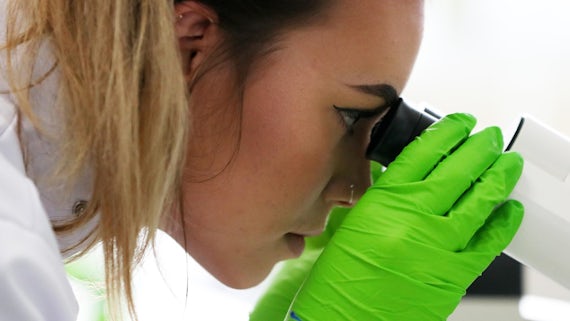
Laboratory Practicals
Seminars
Tutorials
Core Modules English Language & Study Skills
Health & Life Sciences Modules
Cardiff School of Biosciences
The Welsh School of Pharmacy
Programme Structure
We have designed this programme to give you a solid foundation in Biology and Chemistry which will be necessary for your undergraduate studies in Health & Life Sciences, and to give you the best possible information and assistance for your time as a student in the UK. The International Foundation Programme is a modular programme, divided into two main parts:
- Core Modules
- Science Specific Modules
You will take a total of twelve modules, six in each semester.
Teaching and Learning Methods
The course employs several teaching methods, all chosen to deliver the tuition you need in the best possible way.
Lectures
Lectures are classes given to large groups of students. Lectures allow you to gain a comprehensive base of knowledge. Lecturers make use of a range of resources and facilities to provide the information you need. During lectures you will be given written material (handouts), information about exams and essays, and multi-media presentations. You may even find that you are invited to give your own presentation.
Seminars
These are smaller discussion groups of three to ten students, led by tutors. This is an ideal time to discuss any questions after lectures, and an opportunity to fully understand the subjects you are studying.
Tutorials
You can arrange to meet any tutor to discuss any aspect of the course. For example, if there is something you did not understand in a lecture or seminar, or if you want to discuss the progress of your project or essay - or any other topic you want to talk about.
If you have any questions at any time, you are encouraged to meet your tutors who will give you individual attention. Our aim is to provide you with the necessary subject knowledge and study skills for undergraduate study on a competitive degree programme. Although you will need to display personal qualities of determination, self-motivation, enthusiasm and commitment to be successful, you will in return receive guidance and support from the Foundation Programme staff to help you achieve your objectives.
Assessment
A variety of assessment methods are used including written essays, reports, presentations, project work and final examinations. All written tasks are word processed and normally submitted electronically. You will be awarded a score out of 100 for each
module:
40% and above - Pass
50% and above - Merit
65% and above - Distinction
Attendance
Attendance and participation in all classes, lectures, and tutorials on the International Foundation Programme (IFP) at Cardiff University are compulsory and essential for academic success. Please note that, due to new immigration rules, we will be required to keep records of attendance.
English Language Modules
One of the most important aims of the Foundation Programme is to provide the ideal preparation for you to do well in an academic course taught in English. The course will review your knowledge of English grammar and vocabulary and help you to improve so that you can develop a solid foundation for academic use. You will practice reading, writing, listening and speaking to develop accuracy and fluency. The course will include different written and spoken formats to help develop academic style. You will also receive specialist classes to prepare you for the technical vocabulary relevant to Health & Life Sciences.
The modular programme includes:
English Language & Study Skills (10 credits)
Further English Language & Study Skills (10 credits)
English for Academic Purposes (10 credits)
Further English for Academic Purposes (10 credits)
English for Health & Life Sciences (10 credits)
One of the most important aims of the Foundation Programme is to provide the ideal preparation for you to do well in an academic course taught in English. The course will review your knowledge of English grammar and vocabulary and help you to improve so that you can develop a solid foundation for academic use. You will practice reading, writing, listening and speaking to develop accuracy and fluency. The course will include different written and spoken formats to help develop academic style. You will also receive specialist classes to prepare you for the technical vocabulary relevant to Health & Life Sciences.
Study of the culture and requirements of British higher education will prepare you for different teaching and learning methods, such as presenting a seminar or writing an extended essay. By the end of the course you should feel confident enough in your English ability to be able to contribute fully to class discussions, complete written assignments and get the most out of your studies here.
As well as developing your English language and skills for general university purposes, we recognise the importance of subject-specific orientation in the field of Health & Life Sciences. This will involve language and skills development useful for students in your field, for example language for patient care situations. It will incorporate workshops by visiting professionals to introduce you to relevant language, skills and environments.
During the course you will also be given the opportunity to complete a Personal Development Plan (PDP) which will improve your ability to understand what and how you are learning and help you reflect on and plan your own learning. The PDP will help you to get the most out of your student experience by encouraging you to take responsibility for your development and raising your awareness of the variety of opportunities for development. PDP is not just an important process for your time at university but will prove to be a useful skill throughout your life. Learning and development are continual processes and engaging in PDP will
help you to develop a positive attitude to all aspects of learning.
Health & Life Sciences Modules
This part of the programme provides a foundation-level introduction to the Science subjects which will be relevant to your future undergraduate studies in Health and Life Sciences.
The modular programme includes:
- Fundamental Aspects of Chemistry
- Thermodynamics, Kinetics & Equilibria
- Chemistry of Organic Compounds
- Inorganic and Redox Chemistry
- Genetics, Evolution & Diversity
- Cells & the Chemistry of Life
- The Way the Body Works
Fundamental Aspects of Chemistry
This module is designed to introduce basic description of elemental properties and the periodic table, solid and molecular structures and bonding, and to relate these to electronic structure of atoms. The mole as a unit is introduced so that a quantitative treatment of stoichiometry can be considered. Practical work introduces the use and handling of basic chemical equipment.
Thermodynamics, Kinetics & Equilibria
This module provides the basis for a quantitative understanding of (i) the kinetic theory of gases (which is developed to consider the nature of liquids and solids); (ii) equilibria and the concepts of the equilibrium constant and of pH; (iii) energy changes in chemical reactions and the fundamental principles of thermodynamics; (iv) the rates of chemical reactions and the concepts of the rate determining step and the activation energy. Practical work deals with examples of these topics.
Chemistry of Organic Compounds
This module is designed to introduce the main types of organic compounds by reference to simple systems and to specific compounds of biological, medicinal, and dental importance. The more important reactions of each of these types are described, and are explained in terms of the electronic structure of the functional groups involved. The practical work illustrates the basic techniques involved in the preparation, isolation, and purification of organic compounds.
Inorganic and Redox Chemistry
This module treats some basic chemistry of hydrogen and selected elements from the periodic table; simple co-ordination chemistry of metal ions in solution; the ideas of oxidation and reduction in relation to oxidation state changes and electron transfer, and electrode reactions and potentials, are also developed. Practical work examines some of this chemistry and uses oxidation-reduction reactions as a basis for quantitative analysis.
Genetics, Evolution & Diversity
This module deals with the structure, function and transmission of genes and with inheritance of genetically controlled characteristics, including more complex patterns of inheritance brought about by linkage and interaction between genes. This is followed by a brief review of the evidence for evolution and a coverage of evolutionary processes. Finally the module provides the student with an introduction to the diversity of living organisms. The theoretical coverage in lectures and tutorials is supplemented by practical classes which allow examination of cell division in plants and animals , analysis of patterns of inheritance for various genetic traits and examination of a diversity of life forms at both the microscopical and whole organism level.
Cells & the Chemistry of Life
The module provides an introduction to the molecular basis of living organisms. After developing an appreciation of the very "molecules of life" the student goes on to learn how these molecules are organised into cells. The concepts taught in the module are fundamental to all aspects of biology.
The Way the Body Works
This module deals with the broad principles of physiology, the nervous system, its nature, structure and function; the cardiovascular system and the roles of the heart, blood vessels and blood; changes in disease; breathing and lung function; the role of the kidneys; the function of the endocrine system and the physiology of reproduction; the digestion and absorption of food; and finally, with motherhood and the physiology of the new-born child. Opportunities for Undergraduate Study at Cardiff's Science Schools
Set in a magnificent civic campus, Cardiff University has established itself as one of Britain's leading universities. It is an internationally renowned university which attracts students and staff from throughout the UK, and from more than 100 overseas countries. Cardiff is one of the top universities in the UK with both research and teaching independently rated as being of national and international excellence. This creates a stimulating environment for teaching, ensuring that students are exposed to the very latest thinking in their fields and that the most modern technology and equipment are available. In recent assessments of teaching quality Cardiff has scored one of the highest totals in the UK for subjects rated as "Excellent".
Cardiff has large departments in all of the main subject areas and offers a wide range of courses taught by distinguished staff. Some of the courses available for Health & Life Sciences are listed below:
Undergraduate Opportunities at Cardiff University
Cardiff School of Biosciences
- Biochemistry BSc*
- Biology BSc*
- Biomedical Sciences BSc*
- Biomedical Sciences (Anatomy) BSc*
- Biomedical Sciences (Neuroscience) BSc*
- Biomedical Sciences (Pharmacology) BSc*
- Biomedical Sciences (Physiology) BSc*
- Biotechnology BSc*
- Ecology BSc*
- Genetics BSc*
- Microbiology BSc*
- Molecular Biosciences BSc*
- Zoology BSc*
All the courses marked with * have automatic progression from the Foundation Programme, providing that students achieve a merit in each module.
Cardiff School of Biosciences
Cardiff has a large and successful School of Biosciences located in Cathays Park, only a few minutes walk from the city centre. The Students Union and most of the modern university residences are also conveniently close. The School has well equipped modern laboratories, its own libraries, a Teaching and Learning Resource Centre, study areas with fully up-to-date networked computers, and its own Field Centre set in the Welsh countryside near Newbridge on Wye.
The School offers an extensive range of degree schemes in Biological and Biomedical Sciences, all of which have recently been assessed by government-sponsored panels and rated as Excellent - the highest quality rating available. Within each degree scheme you are able to make choices so that your degree will reflect your own special interests.
The School has more than 80 academic staff including more than 20 professors, all of whom are internationally renowned in their area of study. The School has a total student population of over 1,200 and takes in over 320 science undergraduates each year. Although the School is large, it is proud to retain a friendly and supportive atmosphere.
Welsh School of Pharmacy
- Pharmacy MPharm
The Welsh School of Pharmacy
The Welsh School of Pharmacy is a long-established department with an international reputation for excellence. The School enjoys outstanding resources and facilities, including new laboratories and sophisticated equipment.
The Pharmacy degree scheme is a four-year scheme which provides teaching to masters degree level while at the same time equipping you with the vocational skills required to enter the profession. The scheme is fully accredited by the Royal Pharmaceutical Society and the Department was awarded the "excellent" designation in recent teaching quality assessments.
The School has 61 academic, technical and support staff, many of whom are experts in the field of research. Their work attracts grants of £2 million each year from government research councils, pharmaceutical companies and other agencies. About 90 undergraduates are accepted each year and the School has a total student body of 450 which includes a large number of postgraduate students.
The School benefits from excellent staff-student relations and operates a successful "buddy" system for new students (where each new student is assigned an older student to act as a "big brother/sister").
Progression to the undergraduate course in Pharmacy will be subject to application and interview. You will receive help and advice on how to apply for this course during your Foundation Programme.
If you have any queries about any other health related Undergraduate courses at Cardiff University then please contact the IFP office for further information.