Participatory Monitoring of the Planning Process for the Modernization of the Hamburg Fair Trade Centre
Introduction
The modernisation and expansion of the Hamburg trade fair and exhibition centre has been one of the largest current inner urban planning projects in Germany. Half a year into the planning process, due to widespread protest and partly violent resistance the Senate of the City of Hamburg commissioned political scientists Prof. Wolfgang Gessenharter and Dr. Peter H. Feindt to organise a mediated ‘communicative monitoring of the planning process’.

Aims of Project
The aim was to lower the level of conflict and to achieve a 'contract', i.e. an agreement on the essential features of the following architectural competition.
Result
The process consisted of a pre-phase and two main phases. During the pre-phase, 20 in-depth interviews were held with key players from politics, administration, business and neighbourhood initiatives to map the conflict.
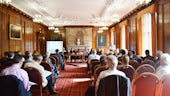
The goal of the first phase was to collect, structure and prioritise the matters of concern. It started with a full day stakeholder workshop with more than 50 representatives and citizens from the three surrounding quarters, 20 members of the different agencies involved and 15 expert witnesses. The expert opinions on environmental emissions and noise, urban planning, architecture and design, green area planning and social and economic impacts were legally required as input to the planning documents. Their scope emerged as the focus of debate and was amended after the workshop. Two citizen workshops with 42 citizens and further activating measures followed. All issues raised at the three workshops were taken up as tasks to be addressed by the expert opinions.
The second phase started with a public hearing of the experts' draft reports with more than 100 participants, live TV and radio broadcasting and broad newspaper coverage. The following first of two full day 'contract workshops' with stakeholders, agencies and experts was open to the public and served to cross-examine the expert witnesses. At the second and final 'contract workshop' more than 70 detailed statements on all facets of the planning process were checked for approval by the different local groups, the exhibition centre's management, agencies and the Senate's representatives. As a result an operational consensus on most issues was agreed and later termed the 'contract'. All parties consented that the participation process should be continued. Finally, a citizens' vote was documented.
Conclusions
Eventually, the communication process helped to clarify interests, find facts in a cooperative way, foster mutual understanding, and build trust between administrators, business community and the groups and initiatives in the three affected quarters. It demonstrated the feasibility of participatory planning for highly complex urban planning projects under immense time pressure.
Funder
Hamburg State and City Ministries for Economy and City Development
Project Value
DM 75.000
Duration
June – November 2000
Additional Information
In cooperation with Prof. Dr. Wolfgang Gessenharter
Final publication: Feindt/Gessenharter 2001
Details available, in German, at: http://www.messe-hamburg-dialog.de/