Skip to content
Skip to navigation menu


Stereochemistry and reactivity (CH2202)

Aims

This module aims to enable learners to understand the essential stereochemical features of molecules and the fundamental mechanistic basis of reaction and thus be able to relate these two important areas of chemistry.

General description

This module provides an understanding of the relationship between the stereochemistry of molecules, including isomerism, chirality, conformation, and reactivity. Essential stereochemical features of organic molecules are analysed and mechanistic discussion of some major organic reactions involving carbonyl compounds, condensation processes and the involvement of reactive intermediates is provided. The properties and reactions of carbocyclic compounds (e.g. cyclohexanes). Topics such as conformational analysis and racemization/resolution of chiral molecules will also be included as well as advanced aspects of substitution and elimination reactions.

Syllabus content

Mechanisms of synthetic reactions :

More detailed mechanistic analysis of reactions than introduced previously. Carbocations. Nucleophilic substitution at saturated and unsaturated carbon. SNi and neighbouring group participation. Elimination reactions. E1 and E2 mechanisms. Syn ’pyrolytic’ eliminations. The reactions of carbonyl compounds and mechanistic analysis of condensation processes, including esterification, hydrolysis, the aldol reaction, amide formation.

Stereochemistry :

3D-formulae and their interconversions. Chirality. Absolute configurations (R/S, E/Z). Compounds with several chiral centres, diastereoisomers and enantiomers, properties of racemates, racemisation. Resolution of racemates. Asymmetric synthesis, Cram’s rule. Conformation of acyclic and six-membered ring systems, conformational free energy differences. Other carbocyclic ring systems, including cyclohexanes, decalins, cycloalkanes in general. Cyclohexenes, Bredt’s rule, reactivity in six-membered ring-systems exemplified by SN2 and E2 processes.

Practical work :

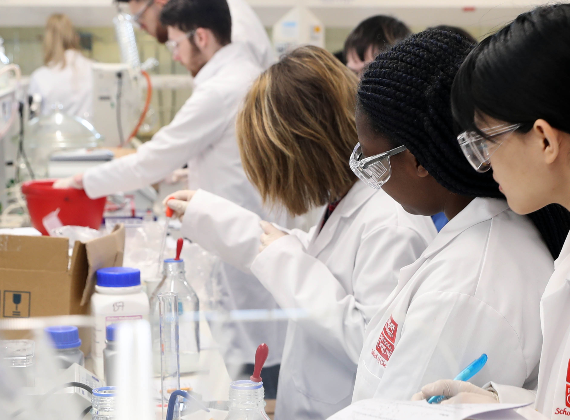
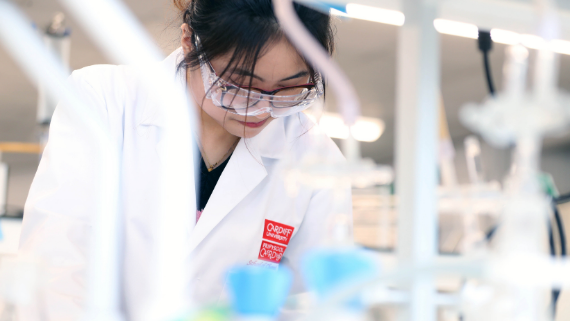
Preparation, characterisation, analysis/interpretation of a range of organic compounds, including : formation of single diastereoisomers from achiral substrates, transformations of functional groups (reduction of ketones, addition to C-C bonds), analysis of compounds with more than one stereogenic cenetre.