Sustainable Chemistry (MSc)

This course will develop in students an understanding of the science behind a range of problems arising in sustainable chemistry. The course will provide opportunities for students to engage with a range of modern organic theories and practical skills, and an understanding of their basis.
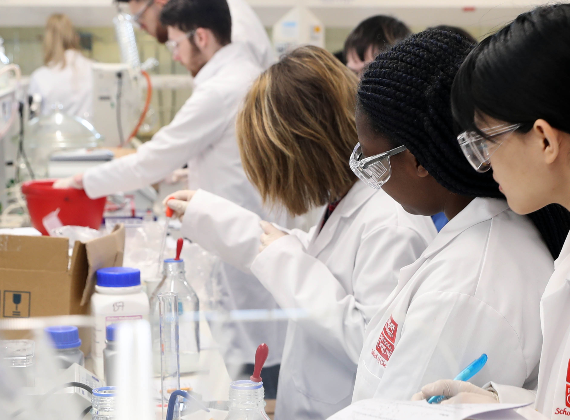
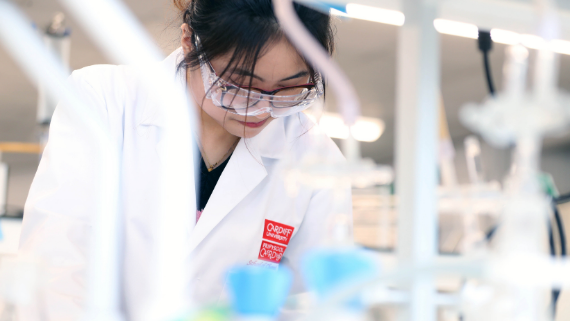
Students are introduced to core organic synthetic methods and analysis applied to sustainable chemistry. The importance and applications of catalysis in hetero/homogeneous and biological environments are also investigated. In addition, the principles and procedures of practical laboratory techniques, especially as applicable to development of sustainable chemical processes are covered. Students are introduced to real world problems through practical applications, visiting lecturers and an extensive summer research project.
The course is designed around a modular system of teaching and assessment, with modules covering the range of both theory and applications of catalysis. Five core and one optional module are taken in the first semester (Sept - Jan), with four core and one optional module in the second (Feb - May). The summer is then spent solely on a research project, running from June to August.
Course Content
Semester 1
- Mathematics for Chemists (10 Credits)
- Chemicals and the Environment(10 Credits)
- Critical Chemical Analysis (10 Credits)
- Retrosynthetic Analysis and Biosynthesis (10 Credits)
- Techniques in Physical Organic Chemistry (10 Credits)
Plus any one from
- Biosynthetic Approach to Natural Products (10 Credits)
- Mechanism and Ligand Design in Homogeneous Catalysis (10 Credits)
- Training in Research Methods in Synthetic Chemistry (10 Credits)
- Biocatalysis I: Modern Approaches to Biocatalysts (10 Credits)
Semester 2
- Practical Catalytic Chemistry (10 Credits)
- Structure and Mechanism in Organic Chemistry (10 Credits)
- Green Chemistry (10 credits)
- Colloquium (10 Credits)
Plus any one from
- Catalysis and Electrocatalysis (10 Credits)
- Heterocycles in Synthesis and Life (10 Credits)
- Current Techniques in Chemical Biology and Modern Applications (10 Credits)
- Homogeneous Catalysis in Industry (10 Credits)
- Industrial Applications of Biocatalysis (10 Credits)
The summer research project (60 credits) is typically chosen from a list of options proposed by course staff, usually in an area of current research interest. More information on these areas can be found here, or on individual staff pages.
The course is taught mainly by members of the Cardiff School of Chemistry. Some modules also feature specialist contributions from external lecturers from other Schools in Cardiff, from industry, and from other universities.
Online Course Material can be accessed through the University’s Learning Central system (Cardiff University users only).
See this course on the University's Coursefinder website.